
CUETMOCK
  • Pricing
  • Mentors
Log inStart freeStart free mocks→

First test, then trust

Try a free CUET mock test.

Join 5,00,000+ students who rehearsed exam day on the exact NTA screen before sitting CUET. On the web and on Android.

Start free mocks →Get the Android app
CUETMOCK

India's #1 CUET Mock Test Platform. Original NCERT-based questions on the exact NTA exam screen — trusted by 5,00,000+ students since CUET 2022.

Get it onGoogle PlayScan to download the CUETMOCK app

Mock tests

  • CUET mock test series
  • Commerce mocks
  • Humanities (Arts) mocks
  • Science mocks
  • Languages & GAT mocks
  • Free practice questions
  • Pricing

Resources

  • CUET exam guide
  • CUET syllabus
  • Universities accepting CUET
  • Expert blogs
  • News & notifications
  • Webinars & counselling
  • CUET score calculator
  • How we estimate your rank
  • FAQs

Company

  • About us
  • Our leadership & team
  • Our toppers
  • Mentors
  • For schools
  • Contact us
  • Terms
  • Privacy
  • Refund policy

Talk to us

+91 7696 6630 56info@cuetmock.comWhatsApp us

Our other platforms

  • JEE Mock — For IIT-JEE aspirants
  • NEET Mock — For NEET aspirants

Newsletter

Exam updates, study material and offers — no spam.

© 2026 NYC Ventures Pvt. Ltd.

701-702, Royal Business Park, Zirakpur, Punjab - 140603

  • Terms of use
  • Privacy policy
  • Refund policy
  • Contact us

iCUETMOCK is an independent preparation platform, not affiliated with the National Testing Agency (NTA). Always check exam details on the official NTA website.

  • Home
  • Mock tests
  • CUET guide
  • Pricing
  • Log in
Home/Practice questions/Biology
BiologyEnvironmental Issues

Increase in concentration of toxicant in the aquatic food chain is:

Increase in concentration of toxicant in the aquatic food chain is:

Answer & explanation+

Correct answer: option 2

The correct answer is Option (2) → Bio-magnification

Option (2) Bio-magnification — Correct. Biomagnification is the increase in concentration of a toxicant at successive trophic levels. It happens because the toxicant (for example DDT or mercury) cannot be metabolised or excreted, so it passes on and builds up.

Note 1: A similar question was also asked in CUET (UG) 2023 on 28-05-2023 (Slot 1).

Note 2: This question is from Chapter 16, Environmental Issues, of the pre-rationalised NCERT book. This chapter is not in the present NCERT book (2026-27). The extract below is from the pre-rationalised edition.

NCERT Extract (Pre-rationalised edition, Chapter 16, Environmental Issues):
Domestic Sewage and Industrial Effluents – “… Biomagnification refers to increase in concentration of the toxicant at successive trophic levels. This happens because a toxic substance accumulated by an organism cannot be metabolised or excreted, and is thus passed on to the next higher trophic level. This phenomenon is well-known for mercury and DDT. Figure 16.5 shows biomagnification of DDT in an aquatic food chain. In this manner, the concentration of DDT is increased at successive trophic levels; say if it starts at 0.003 ppb (ppb = parts per billion) in water, it can ultimately reach 25 ppm (ppm = parts per million) in fish-eating birds, through biomagnification.”
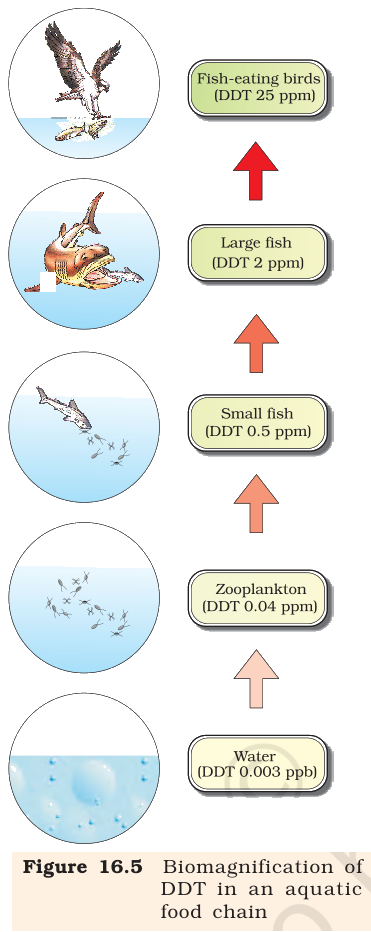
Textbook figure

Advertisement

Practise more on Environmental Issues

Chapter-wise mocks on the real NTA exam screen, with solutions and your rank. Your first mocks are free.

Start free mocks →

Advertisement

Next questions

  1. In the study of social inequality and exclusion in India, which of the following describes Dalits?Sociology · Indian Society: Patterns of Social Inequality and Exclusion
  2. At the 65th Filmfare Awards, the film ‘Gully Boys’ did NOT win the award for which of the following categories?General Aptitude Test · General Knowledge
  3. If x2 - 5x + 25 = 0 Find the value of x5 - 5x4 - 3102General Aptitude Test · Quantitative Reasoning
  4. The literary device used in the expression -- 'the doors closing behind him with a soft hiss' is _______.English · Comprehension - (Narrative / Factual)
  5. X takes 10 days less than the time taken by Y to finish a piece of work. X and Y together can do it in 12 days. In how many days Y alone ca…General Aptitude Test · Numerical Ability
  6. Study the given table and answer the question that follows. Partners Present share in percentage Shourya 18% Tanmay 22% Bhanu 25% Dhanya 35…General Aptitude Test · Quantitative Reasoning
  7. Rate constant of a first order reaction follows following equation log k = 8.0-5000/T . The E_a for the reaction is: (Given R=8.3 JK^-1mol^…Chemistry · Physical: Chemical Kinetics
  8. 20 workers can paint 24 walls in 36 days. In how many days can 30 workers paint 20 walls?General Aptitude Test · Numerical Ability
  9. Assertion:. The sex ratio is an important information about the status of women in a country. Reasoning: In regions where gender discrimina…Geography · Fundamentals of Human Geography: Population Composition
  10. The histogram shows the marks scored by 40 students in a test with maximum 30 marks. What is the percentage of the students who scored less…General Aptitude Test · Quantitative Reasoning