
Read the passage carefully and answer.
The molar conductivity of a solution at any given concentration is the conductance of the volume of solution containing one mole of electrolyte kept between two platinum electrodes with unit area of cross-section and at a distance of unit length. Both conductivity and molar conductivity change with the concentration of the electrolyte. Kohlrausch examined $Ʌ°_m$ values for a number of strong electrolytes and observed certain regularities. He noted that the difference in $Ʌ°_m$ of the electrolytes NaX and KX for any X is nearly constant. On the basis of the above observations, he enunciated the Kohlrausch law of independent migration of ions.
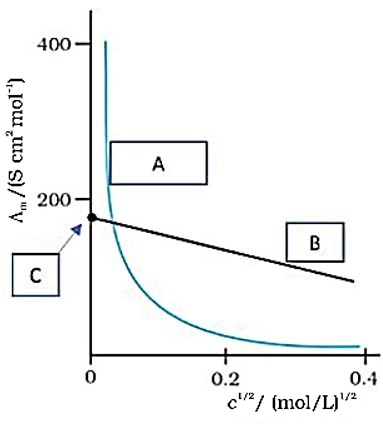
Point C in the image is called
Answer & explanation
Correct answer: option 4
The correct answer is Option (4) → Limiting molar conductivity
Understanding the Graph
The image displays a plot of molar conductivity ($\Lambda_m$) against the square root of concentration ($c^{1/2}$). This relationship helps distinguish between how different electrolytes conduct electricity as they are diluted.
- Point C: This represents the value of molar conductivity when the concentration of the electrolyte approaches zero (infinite dilution). It is denoted by the symbol $\Lambda^\circ_m$.
- Electrolyte B (Straight Line): Represents a strong electrolyte (like $KCl$). Its molar conductivity increases slowly and linearly with dilution, following the Debye-Hückel-Onsager equation: $\Lambda_m = \Lambda^\circ_m - A \sqrt{c}$. Point C is found by extrapolating this line to the y-axis.
- Electrolyte A (Curved Line): Represents a weak electrolyte (like $CH_3COOH$). Its molar conductivity increases steeply at very low concentrations due to increased dissociation. Because the curve becomes nearly vertical, $\Lambda^\circ_m$ (Point C) cannot be found by simple extrapolation and instead requires Kohlrausch's Law of independent migration of ions.
Correct Option: Limiting molar conductivity