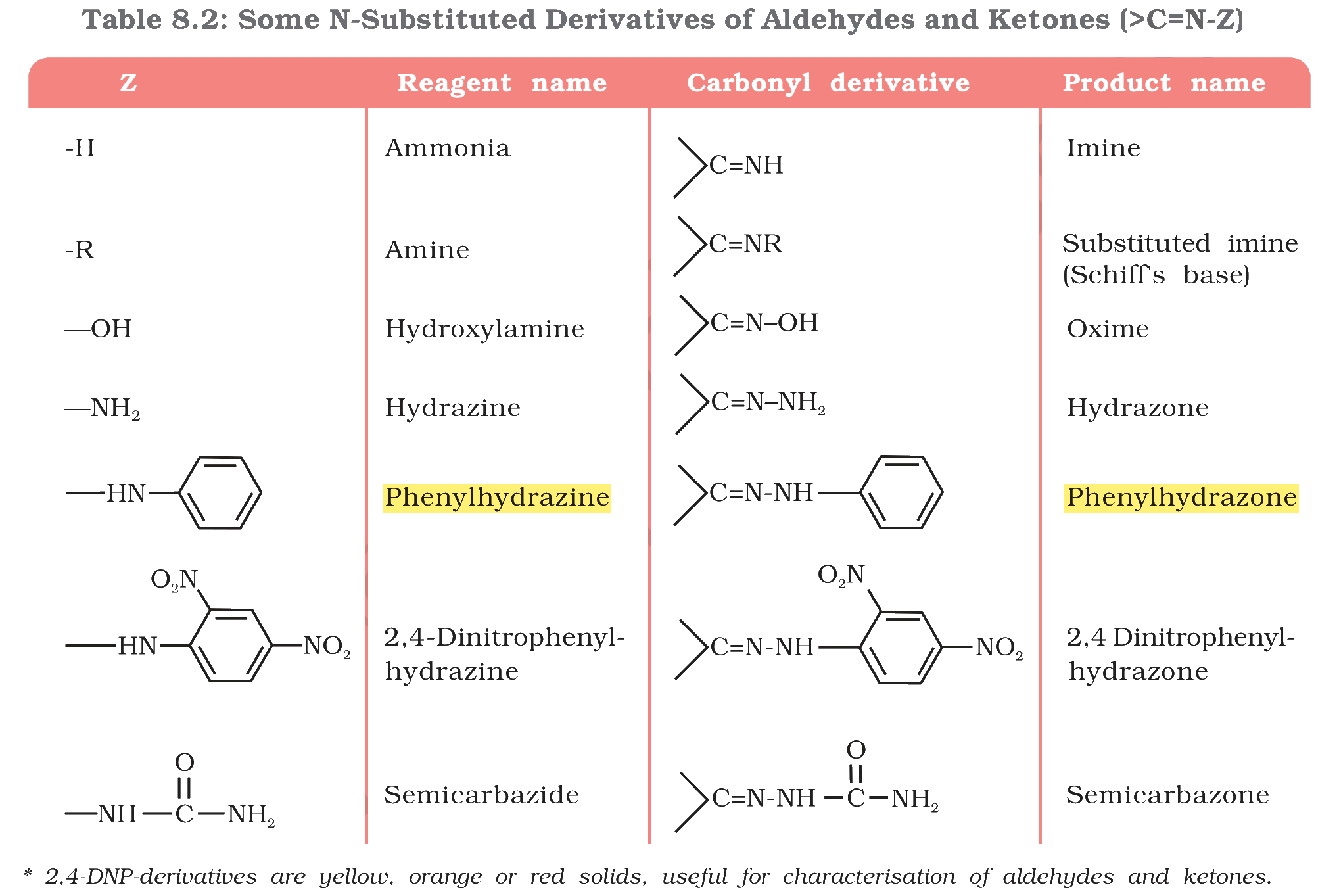
Nucleophiles such as ammonia and its derivatives, \(H_2N-Z\), add to the carbonyl group of aldehydes and ketones. The reaction is reversible and catalysed by acid. The equilibrium favours product formation due to rapid dehydration of the intermediate to form \(-C=N-Z\), where Z = alkyl, aryl, OH, NH2, C6H5NH, NHCONH2, etc.
What is formed when acetone reacts with phenylhydrazine?
Answer & explanation
Correct answer: option 2
The correct answer is Option (2) → Acetone phenylhydrazone
The passage states that a reagent \( \ce{H2N-Z} \) adds to the carbonyl group and the intermediate loses water to give >C=N–Z. Phenylhydrazine is \( \ce{H2N-NH-C6H5} \), so Z = –NHC6H5:
\( \displaystyle \ce{(CH3)2C=O + H2N-NH-C6H5} \xrightarrow{\ce{H^+}} \ce{(CH3)2C=N-NH-C6H5 + H2O} \)
The product of a carbonyl compound with phenylhydrazine is a phenylhydrazone; here it is acetone phenylhydrazone.
Why the other options are incorrect
Option (1) Acetone hydrazone — Incorrect. A hydrazone, >C=N–NH2, forms with hydrazine (Z = –NH2); it has no phenyl group.
Option (3) Acetone oxime — Incorrect. An oxime, >C=N–OH, forms with hydroxylamine (Z = –OH).
Option (4) Acetone semicarbazone — Incorrect. A semicarbazone, >C=N–NHCONH2, forms with semicarbazide (Z = –NHCONH2).
NCERT (2026-27 edition):
Table 8.2: Some N-Substituted Derivatives of Aldehydes and Ketones (>C=N-Z)