
The figure shows a Daniell cell connected to an external source whose potential (Eext) opposes the cell potential, in three set-ups (a), (b) and (c).
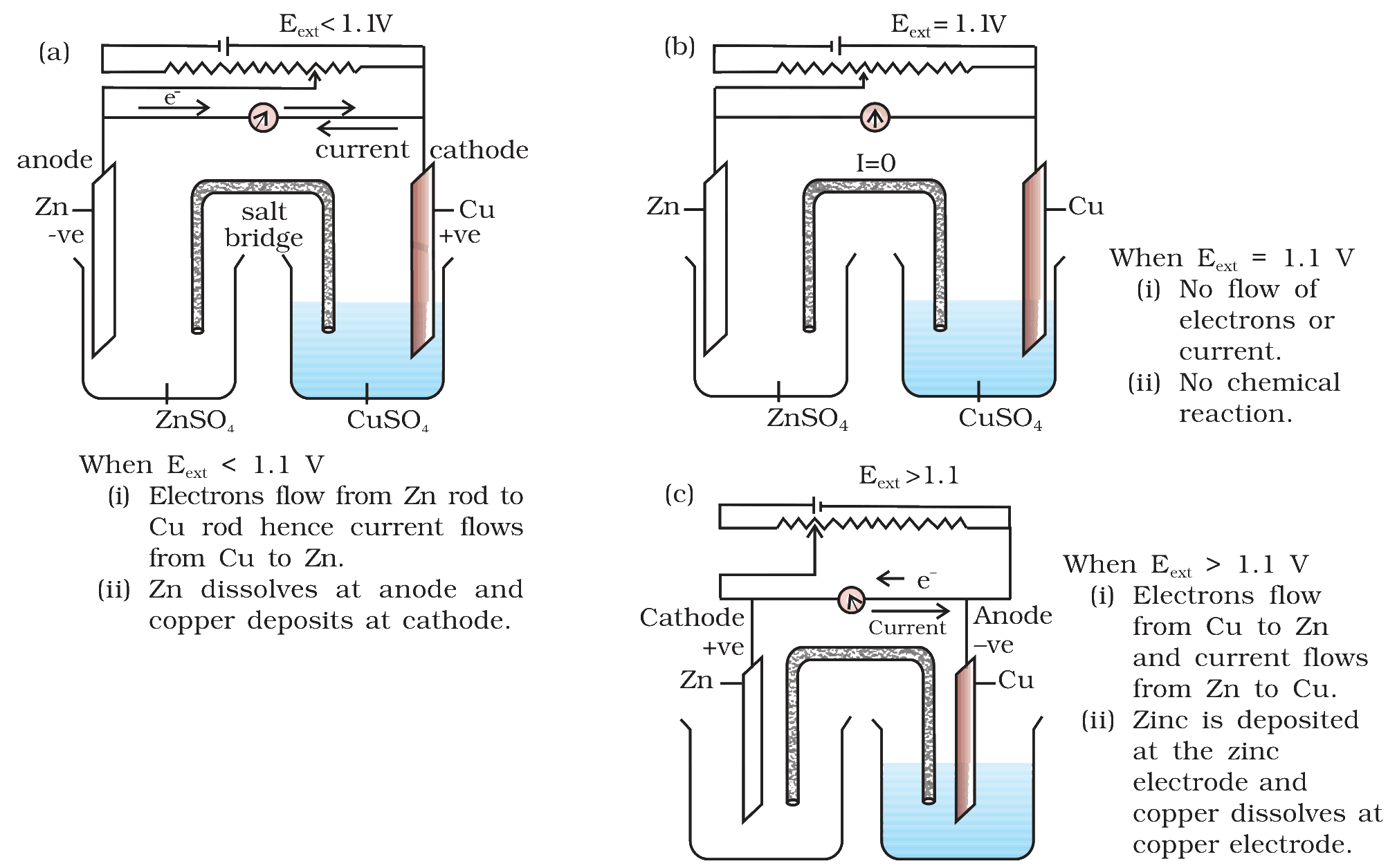
In which of the set-ups does the cell function as an electrolytic cell?
Answer & explanation
Correct answer: option 4
The correct answer is Option (4) → (c) only
An electrolytic cell uses electrical energy from an external source to carry out a non-spontaneous reaction. In set-up (c), Eext is greater than 1.1 V: electrons now flow from Cu to Zn, zinc is deposited and copper dissolves. The cell reaction runs in the opposite direction, driven by the external source, so the cell functions as an electrolytic cell:
\( \ce{Zn^2+ + Cu -> Zn + Cu^2+} \)
Why the other options are incorrect
Option (1) (a) only — Incorrect. In (a), Eext is less than 1.1 V: electrons still flow from Zn to Cu, zinc dissolves and copper is deposited, so the cell still works as a galvanic cell.
Option (2) (b) only — Incorrect. In (b), Eext = 1.1 V and I = 0: there is no flow of electrons or current and no chemical reaction, so the cell is neither galvanic nor electrolytic.
Option (3) (a) and (c) — Incorrect. Set-up (c) is right, but in (a) the spontaneous reaction Zn + Cu2+ → Zn2+ + Cu still runs, so (a) is a galvanic cell.
NCERT (2026-27 edition):
2.1 Electrochemical Cells – “If an external opposite potential is applied in the galvanic cell [Fig. 2.2(a)] and increased slowly, we find that the reaction continues to take place till the opposing voltage reaches the value 1.1 V [Fig. 2.2(b)] when, the reaction stops altogether and no current flows through the cell. Any further increase in the external potential again starts the reaction but in the opposite direction [Fig. 2.2(c)]. It now functions as an electrolytic cell, a device for using electrical energy to carry non-spontaneous chemical reactions.”
Fig. 2.2: Functioning of Daniell cell when external voltage Eext opposing the cell potential is applied.