
Four equal charges Q are placed at the four corners of a square of side 'a'. Work done in removing a charge -Q from its centre to infinity is:
Answer & explanation
Correct answer: option 3
The correct answer is Option (3) → $\frac{\sqrt{2} Q^2}{\pi \epsilon_{o} a} V$
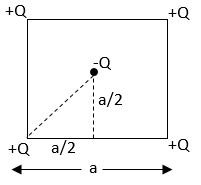
The potential due to a single charge Q at a distance r is -
$V=\frac{kQ}{r}$
and,
Distance from center to vertices = $r=\frac{\sqrt{2}a}{2}=\frac{a}{\sqrt{2}}$
∴ Potential due to all 4 charges = $4×\frac{kQ\sqrt{2}}{a}=4×\frac{Q\sqrt{2}}{4πε_0a}$
$=\frac{Q\sqrt{2}}{πε_0a}$
$W=-qV$
$=-(-Q)×\frac{Q\sqrt{2}}{πε_0a}=\frac{Q^2\sqrt{2}}{πε_0a}$