Allyl phenyl ether can be obtained by heating.
Answer & explanation
Correct answer: option 2
The correct answer is Option (2) → \(CH_2=CHCH_2 Br\) and \(C_6H_5ONa\)
In Williamson synthesis the phenoxide ion displaces the halide by back-side attack, so the halogen must be on an sp3 carbon; a halogen on an sp2 carbon (vinylic or aryl) is not displaced.
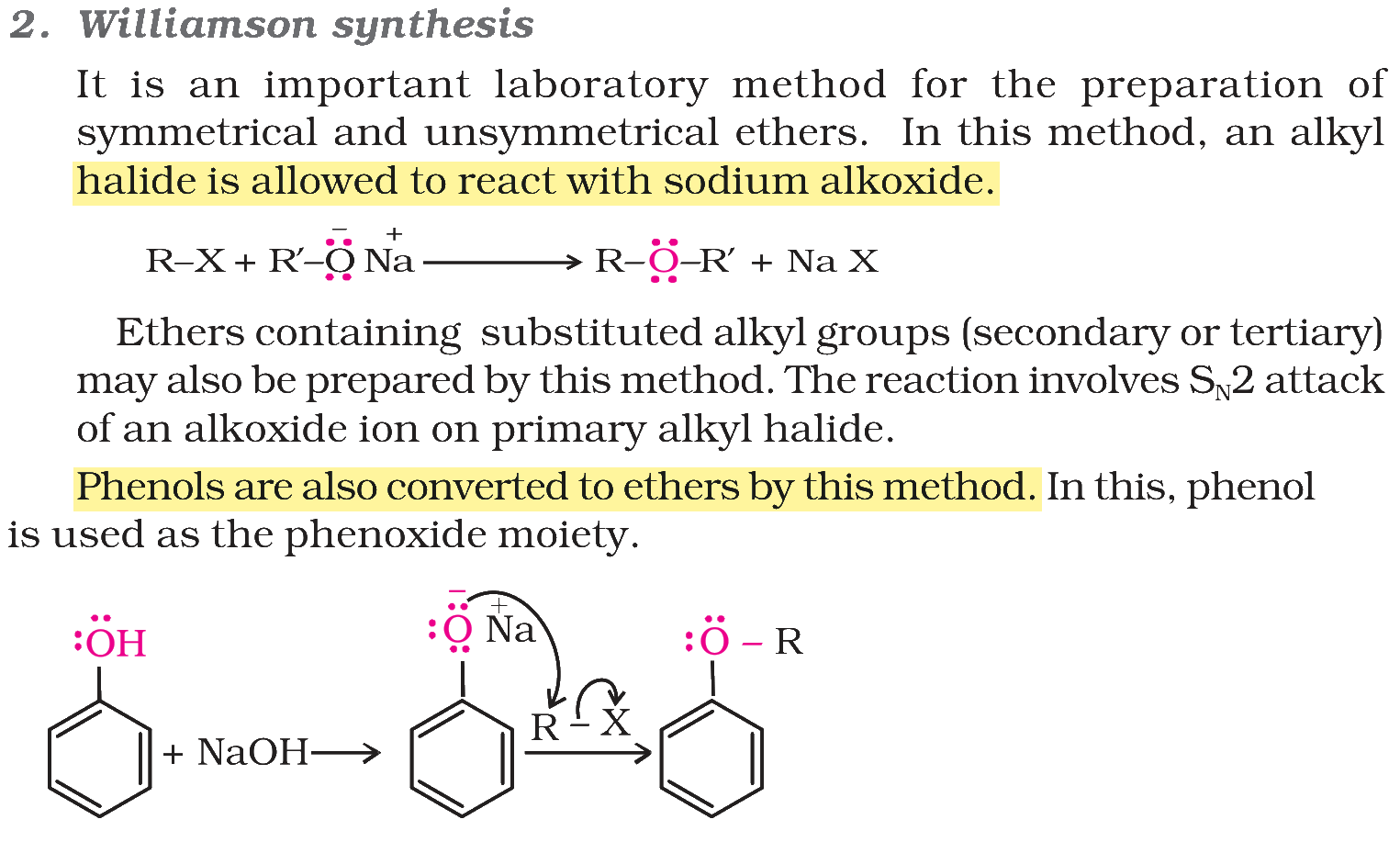
Allyl phenyl ether is \( \ce{C6H5-O-CH2-CH=CH2} \): a phenyl group and an allyl group (\( \ce{CH2=CH-CH2-} \)) on oxygen. The phenyl part comes from sodium phenoxide and the allyl part from allyl bromide, whose bromine is on a primary sp3 carbon next to the double bond:
\( \displaystyle \ce{C6H5ONa + CH2=CHCH2Br} \xrightarrow{\text{heat}} \ce{C6H5OCH2CH=CH2 + NaBr} \)
So the reagents are \( \ce{CH2=CHCH2Br} \) and \( \ce{C6H5ONa} \).
Why the other options are incorrect
Option (1) \(CH_2=CHBr\) and \(C_6H_5ONa\) — Incorrect. Vinyl bromide has its bromine on an sp2 carbon; the C–Br bond has partial double bond character and is not displaced by the phenoxide ion. Even if it were, the product would be a vinyl ether, with two carbons, not the allyl ether.
Option (3) \(CH_2=CH Br\) and \(C_6H_5CH=CH_2ONa\) — Incorrect. Vinyl bromide again does not undergo substitution, and the second reagent is not sodium phenoxide, so no phenyl–oxygen–allyl link can form.
Option (4) \(CH_2=C=CHBr\) and \(C_6H_5ONa\) — Incorrect. In this bromoallene the bromine is also on an sp2 carbon, and its carbon skeleton is not the allyl group.
NCERT (2026-27 edition):
Williamson Synthesis