Match List - I with List - II.
| List - I | List - II | ||
| (Period) | (Approaches of Human Geography) | ||
| (A) | 1930 through the Inter-war period | (I) | Post-modernism in geography |
| (B) | Late 1950 to the late 1960 | (II) | Emergence of humanistic approach |
| (C) | 1970s | (III) | Areal differentiation |
| (D) | 1990s | (IV) | Spatial organisation |
Choose the correct answer from the options given below:
Answer & explanation
Correct answer: option 3
The correct answer is Option (3) → (A)-(III), (B)-(IV), (C)-(II), (D)-(I)
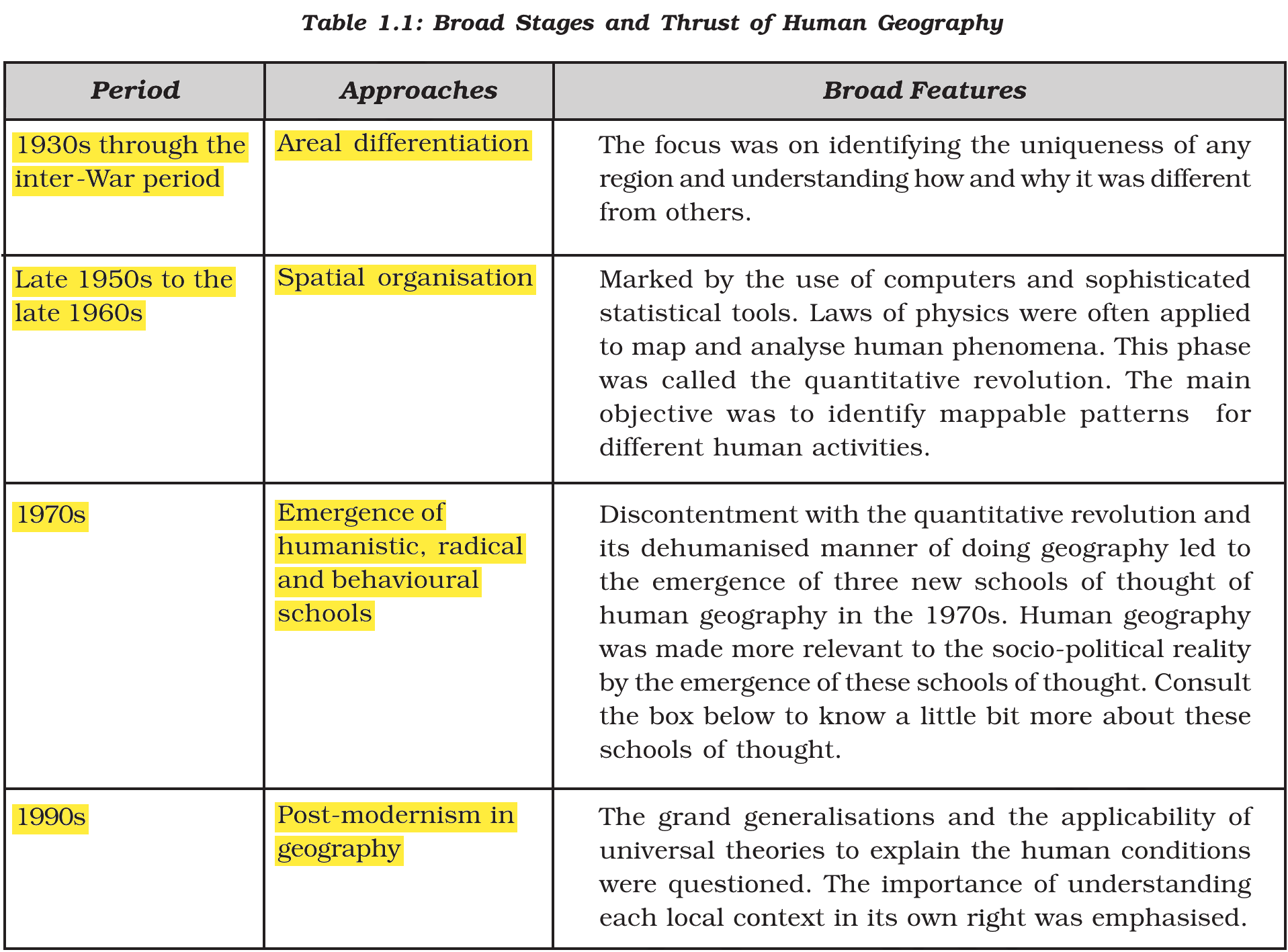
(A) 1930 through the Inter-war period — this matches (III) Areal differentiation. Geographers tried to find what makes each region unique and different from others.
(B) Late 1950 to the late 1960 — this matches (IV) Spatial organisation. Computers and statistical tools were used to map human activities. This phase was the quantitative revolution.
(C) 1970s — this matches (II) Emergence of humanistic approach. Humanistic, radical and behavioural schools of thought emerged in the 1970s. The humanistic school is one of these three schools.
(D) 1990s — this matches (I) Post-modernism in geography. Grand generalisations and universal theories were questioned, and each local context was studied in its own right.
Note: A similar question was also asked in CUET (UG) 2026 on 24-05-2026 (Slot 1).
NCERT (2026-27):
Table 1.1: Broad Stages and Thrust of Human Geography |