
Electrochemical Cell
A galvanic cell is an electrochemical cell that converts chemical energy of a spontaneous redox reaction into electrical energy. It consists of two half cells, the half cell in which oxidation takes place is called as anode and the other half cell where reduction takes place is called as cathode. Anode has negative potential with respect to the solution whereas cathode has positive potential with respect to the solution. As soon as the switch is in the on position, the electrons flow from the negative electrode to positive electrode and the direction of current flow is opposite to that of electron flow. The potential difference between two electrodes is called cell potential and is measured in volts. When no current is drawn from the cell, then cell potential is termed as cell electromotive force. The cell potential is given by Nernst equation.
The standard electrode potential for the Daniell cell is 1.1 V. Calculate the standard Gibbs energy at 298 K.
Given: Faraday Constant = 96500 C mol−1
Answer & explanation
Correct answer: option 3
The correct answer is Option (3) → −212.3 kJ mol−1
A galvanic cell does electrical work at the cost of the reaction’s Gibbs energy. For n moles of electrons passing through a cell of standard emf E°cell:
\( \displaystyle \Delta_rG^{\circ}=-nFE^{\circ}_{cell} \)
A positive E°cell gives a negative ΔG°, which means the cell reaction is spontaneous.
For the Daniell cell:
\( \displaystyle \ce{Zn(s) + Cu^2+(aq) -> Zn^2+(aq) + Cu(s)} \)
Anode: \( \ce{Zn(s) -> Zn^2+(aq) + 2e^-} \); cathode: \( \ce{Cu^2+(aq) + 2e^- -> Cu(s)} \); so n = 2.
E°cell = E°cathode − E°anode = 0.34 − (−0.76) = 1.10 V.
\( \displaystyle \Delta_rG^{\circ}=-2\times96500\ \mathrm{C\,mol^{-1}}\times1.10\ \mathrm{V} \)
\( \displaystyle \Delta_rG^{\circ}=-212300\ \mathrm{J\,mol^{-1}} \)
\( \displaystyle \Delta_rG^{\circ}=-212.3\ \mathrm{kJ\,mol^{-1}} \)
Shortcut: 2 × 96500 × 1.1 ≈ 212000 J, which is about 212 kJ. Only Options (1) and (3) show 212.3, and only Option (3) has the sign right.
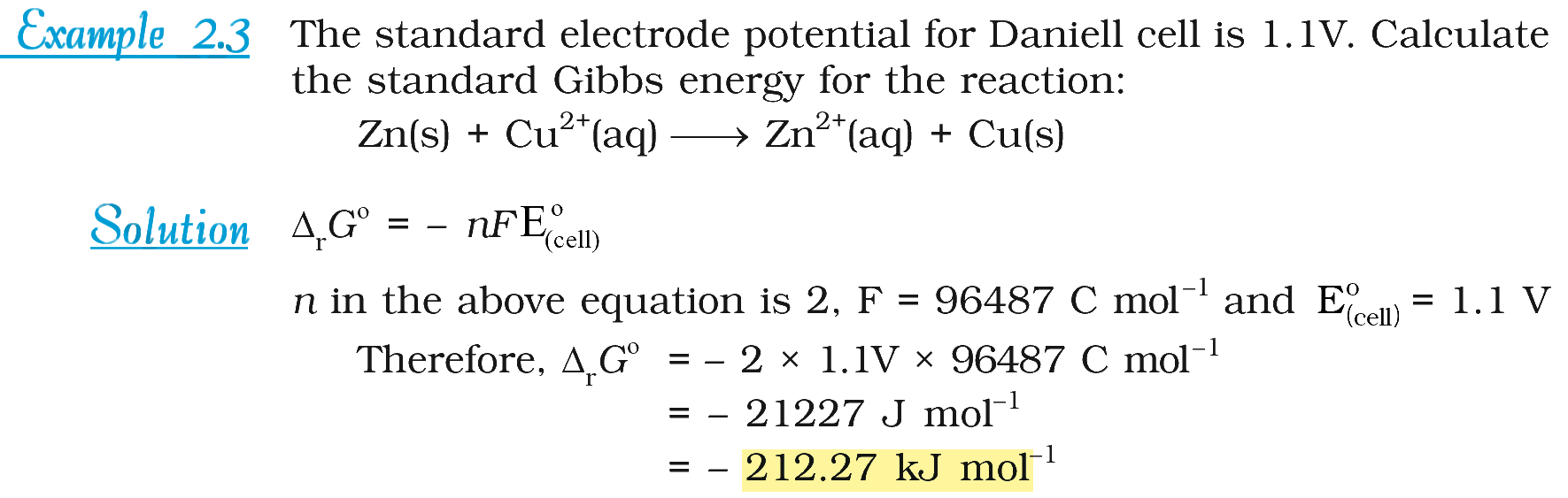
Note 1: In the book’s working (extract below), the value in joules is printed as −21227 J mol−1; it should be −212270 J mol−1, which is the −212.27 kJ mol−1 given on the next line.
Note 2: This question is from NCERT (2026-27). NTA sets numerical questions from NCERT too, so do not ignore NCERT while practising numericals.
NCERT (2026-27 edition):
Electrochemical Cell and Gibbs Energy of the Reaction – …
Note 3: The same/similar question has been asked in different years by NTA as per the details given below:
| 2026 | 2025 | 2024 | 2023 | 2022 |
|---|---|---|---|---|
| 30-05 S1 29-05 S2 29-05 S1 11-05 S1 | 29-05 S1 26-05 S2 | 19-07 S1 | 22-06 S3 12-06 S3 | – |