
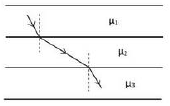
Path of a ray of light passing through three liquids of refraction indices, \( \mu_1, \mu_2, \mu_3 \), is shown below. The liquid which has smallest index of refraction is:
Answer & explanation
Correct answer: option 2
The correct answer is Option (2) → \( \mu_2 \)
At each plane interface the ray obeys Snell's law. Because the boundaries are parallel, the quantity \( \mu\sin\theta \) is the same in all three liquids, where \( \theta \) is the angle between the ray and the normal.
\( \mu_1\sin\theta_1 = \mu_2\sin\theta_2 = \mu_3\sin\theta_3 \)
So the liquid in which the ray makes the largest angle with the normal has the smallest refractive index. In the figure the ray bends away from the normal on entering the second liquid, so \( \theta_2 \gt \theta_1 \) and \( \mu_2 \lt \mu_1 \). It bends towards the normal on entering the third liquid, so \( \theta_3 \lt \theta_2 \) and \( \mu_3 \gt \mu_2 \).
\( \mu_2 \lt \mu_1 \quad\text{and}\quad \mu_2 \lt \mu_3 \)
The smallest refractive index is that of \( \mu_2 \).