
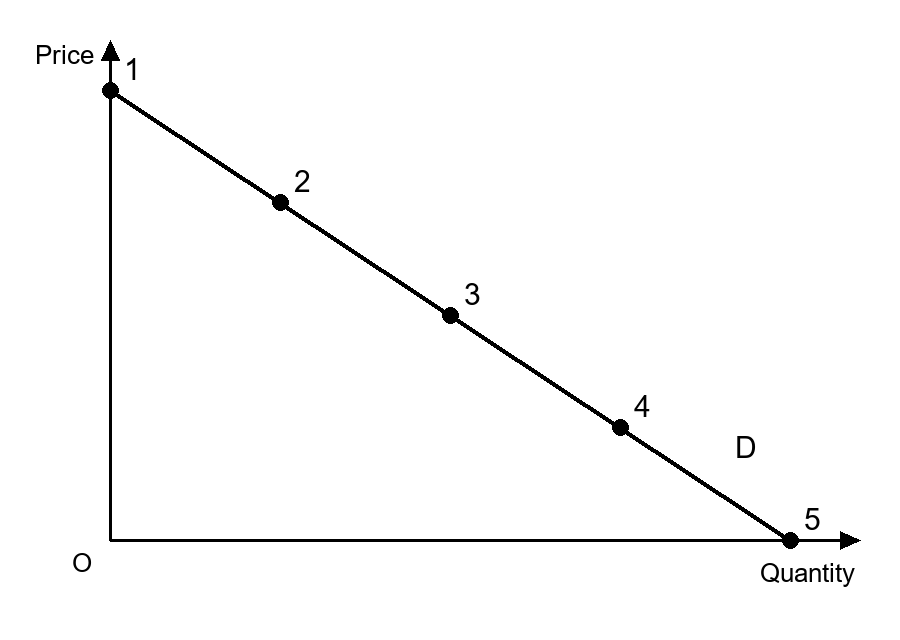
The figure shows a straight-line demand curve D with five points marked 1 to 5. Point 3 is the midpoint of the curve.
Match the price elasticity of demand (absolute value) in List-I with the point in List-II.
| List-I | List-II | ||
|---|---|---|---|
| (A) | Infinite | (I) | Point 3 |
| (B) | Greater than 1 but finite | (II) | Point 5 |
| (C) | Equal to 1 | (III) | Point 1 |
| (D) | Zero | (IV) | Point 2 |
Choose the correct answer from the options given below:
Answer & explanation
Correct answer: option 3
The correct answer is Option (3) → (A) - (III), (B) - (IV), (C) - (I), (D) - (II)
On a straight-line demand curve, elasticity changes from point to point. It is infinite where the curve meets the price axis, 1 at the midpoint, and zero where it meets the quantity axis.
| List-I | List-II | Reason |
|---|---|---|
| (A) Infinite | (III) Point 1 | Point 1 is on the price axis. |
| (B) Greater than 1 but finite | (IV) Point 2 | Point 2 lies to the left of the midpoint. |
| (C) Equal to 1 | (I) Point 3 | Point 3 is the midpoint. |
| (D) Zero | (II) Point 5 | Point 5 is on the quantity axis. |
Point 4 lies to the right of the midpoint, where elasticity is less than 1.
NCERT (2026-27): “Geometric Measure of Elasticity along a Linear Demand Curve The elasticity of a linear demand curve can easily be measured geometrically. The elasticity of demand at any point on a straight line demand curve is given by the ratio of the lower segment and the upper segment of the demand curve at that point. …” “The elasticity of demand at different points on a straight line demand curve can be derived by this method. Elasticity is 0 at the point where the demand curve meets the horizontal axis and it is ∝ at the point where the demand curve meets the vertical axis. At the midpoint of the demand curve, the elasticity is 1, at any point to the left of the midpoint, it is greater than 1 and at any point to the right, it is less than 1. …” |