Shapes of the Long Run Cost Curves
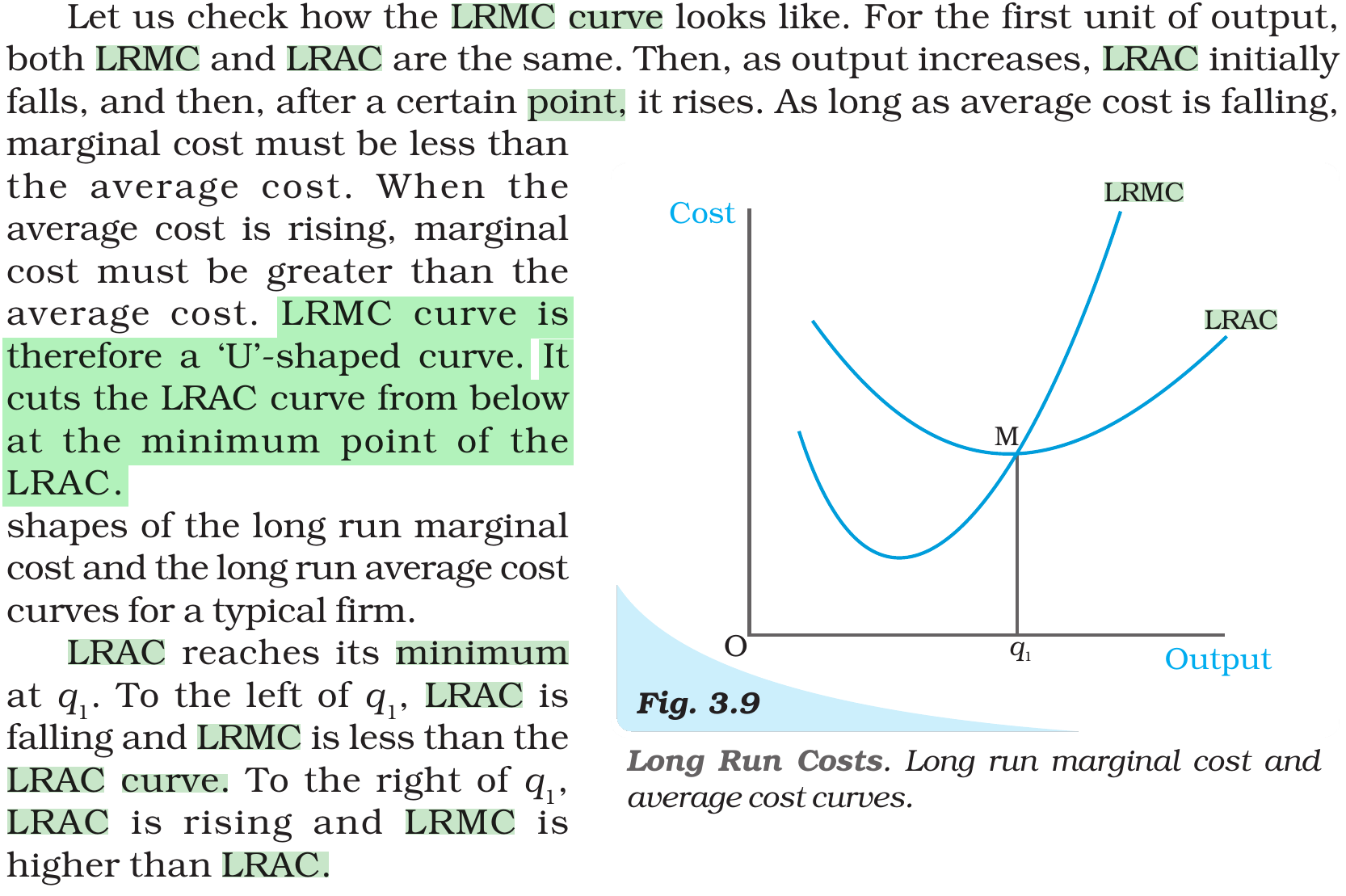
It is argued that in a typical firm IRS is observed at the initial level of production. This is then followed by the CRS and then by the DRS. LRAC curve downward sloping part corresponds to IRS and upward rising part corresponds to DRS. At the minimum point of the LRAC curve, CRS is observed. For the first unit of output, both LRMC and LRAC are the same. Then, as output increases, LRAC initially falls, and then, after a certain point, it rises. As long as average cost is falling, marginal cost must be less than the average cost. When the average cost is rising, marginal cost must be greater than the average cost. LRMC curve cuts the LRAC curve from below at the minimum point of the LRAC.
LRMC cuts the LRAC curve from below at the point where ..............
Answer & explanation
Correct answer: option 2
The correct answer is Option (2) → LRAC is at minimum
The LRMC curve cuts the LRAC curve from below at the minimum point of LRAC. At that point LRMC equals LRAC.
While LRMC is below LRAC, it pulls the average down, so LRAC falls. Once LRMC rises above LRAC, it pulls the average up, so LRAC rises. The two curves meet where LRAC stops falling and starts rising, that is, at its lowest point.
Option (1) LRMC is at minimum — Incorrect. LRMC reaches its lowest point earlier, while it is still below LRAC. It then rises and meets LRAC later.
Option (2) LRAC is at minimum — Correct. To the left of this point LRAC is falling and LRMC is below it. To the right, LRAC is rising and LRMC is above it.
Option (3) LRAC is at maximum — Incorrect. The LRAC curve is ‘U’-shaped. It has a lowest point but no highest point.
Option (4) LRMC is at maximum — Incorrect. LRMC is also ‘U’-shaped. After its lowest point it keeps rising, so it has no maximum.
NCERT (2026-27): Introductory Microeconomics — Chapter 3: Production and Costs
|