
Three circuits are shown below in which same alternating current is flowing. What will be the effect on currents in three cases respectively if frequency of alternating emf be increased?
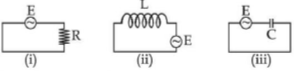
Answer & explanation
Correct answer: option 2
The correct answer is Option (2) → No effect; decrease; increase
For the same emf, the current in each circuit is the emf divided by the opposition of its single element, and only the reactances depend on the frequency \( f \).
\( \text{(i) resistor: } R \text{ does not depend on } f \)
\( \text{(ii) inductor: } X_L = 2\pi f L \text{ rises with } f \)
\( \displaystyle \text{(iii) capacitor: } X_C = \frac{1}{2\pi f C} \text{ falls with } f \)
So, as the frequency increases:
(i) the current through the resistor is unchanged, so there is no effect;
(ii) \( X_L \) increases, so the current decreases;
(iii) \( X_C \) decreases, so the current increases.
NCERT (2026-27):
Summary – “… 3. An ac voltage v = vm sin ωt applied to a pure inductor L, drives a current in the inductor i = im sin (ωt − π/2), where im = vm/XL. XL = ωL is called inductive reactance. …
4. An ac voltage v = vm sinωt applied to a capacitor drives a current in the capacitor: i = im sin (ωt + π/2). Here,
\( \displaystyle i_m = \frac{v_m}{X_C}, \quad X_C = \frac{1}{\omega C} \)
is called capacitive reactance.”