
CUETMOCK
  • Pricing
  • Mentors
Log inStart freeStart free mocks→

First test, then trust

Try a free CUET mock test.

Join 5,00,000+ students who rehearsed exam day on the exact NTA screen before sitting CUET. On the web and on Android.

Start free mocks →Get the Android app
CUETMOCK

India's #1 CUET Mock Test Platform. Original NCERT-based questions on the exact NTA exam screen — trusted by 5,00,000+ students since CUET 2022.

Get it onGoogle PlayScan to download the CUETMOCK app

Mock tests

  • CUET mock test series
  • Browse all papers
  • Commerce mocks
  • Humanities (Arts) mocks
  • Science mocks
  • Languages & GAT mocks
  • Free practice questions
  • Pricing

Resources

  • CUET exam guide
  • CUET syllabus
  • Universities accepting CUET
  • Expert blogs
  • News & notifications
  • Webinars & counselling
  • CUET score calculator
  • How we estimate your rank
  • FAQs

Company

  • About us
  • Our leadership & team
  • Our toppers
  • Mentors
  • For schools
  • Contact us
  • Terms
  • Privacy
  • Refund policy

Talk to us

+91 7696 6630 56info@cuetmock.comWhatsApp us

Our other platforms

  • JEE Mock — For IIT-JEE aspirants
  • NEET Mock — For NEET aspirants

Newsletter

Exam updates, study material and offers — no spam.

© 2026 NYC Ventures Pvt. Ltd.

701-702, Royal Business Park, Zirakpur, Punjab - 140603

  • Terms of use
  • Privacy policy
  • Refund policy
  • Contact us

iCUETMOCK is an independent preparation platform, not affiliated with the National Testing Agency (NTA). Always check exam details on the official NTA website.

  • Home
  • Mock tests
  • CUET guide
  • Pricing
  • Log in
Home/Practice questions/General Aptitude Test
General Aptitude TestQuantitative ReasoningData Interpretation & Stats

The number of people owning books more than 20 but less than 60 is

From the graph given below, answer the following questions.
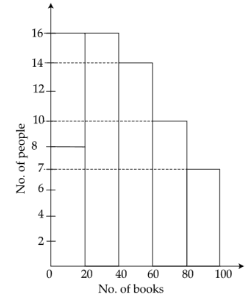
The number of people owning books more than 20 but less than 60 is

Answer & explanation+

Correct answer: option 3

The correct answer is Option (3) → 30

“More than 20 but less than 60 books” covers two classes of the histogram, 20–40 and 40–60, so the heights of these two bars are added.

  • 20–40 books: 16 people

  • 40–60 books: 14 people

  • Total \(=16+14=30\)

The 16 in Option (2) is only the first of the two bars, and 14 in Option (1) only the second.

Advertisement

Practise more on Quantitative Reasoning

Chapter-wise mocks on the real NTA exam screen, with solutions and your rank. Your first mocks are free.

Start free mocks →

Advertisement

Next questions

  1. The concept of balance in attitude change focuses on the relationships between three components. Which of the following represents these co…Psychology · Attitudes and Social Cognition
  2. The issue of relocation and proper rehabilitation of the project-affected (Sardar Sarovar Project) people was first raised by whom?Political Science · Politics in India Since Independence: Rise of Popular Movements
  3. What was the name of the State for which Laldenga became Chief Minister after reaching an agreement with the Prime Minister?1) Meghalaya2)…Political Science · Politics in India Since Independence: Regional Aspirations
  4. Find the number of rectangles in this figure?General Aptitude Test · Verbal Reasoning
  5. Select the most appropriate meaning of the underlined idiom. Hats off to someoneEnglish · Grammar: Idioms
  6. Bombay-Thane linking railway bridge was established in which year?Economics · Indian Economic Development: Indian Economy on the Eve of Independence
  7. Select the most appropriate ANTONYM of the given word. MoilEnglish · Antonyms
  8. Why did the academic style embraced by Raja Ravi Varma come to be looked down upon in India by the end of the nineteenth century?1) It was…Fine Arts · The Bengal School and Cultural Nationalism
  9. The government policy affecting the personal disposable income of households by making transfers and collecting taxes is known by...........Economics · Macro Economics: Government Budget and Economy
  10. The 'Purna Swaraj' was observed on which of the following dates?History · Modern India: Mahatma Gandhi and the Nationalist movement