Excess demand is a situation in which:
Answer & explanation
Correct answer: option 1
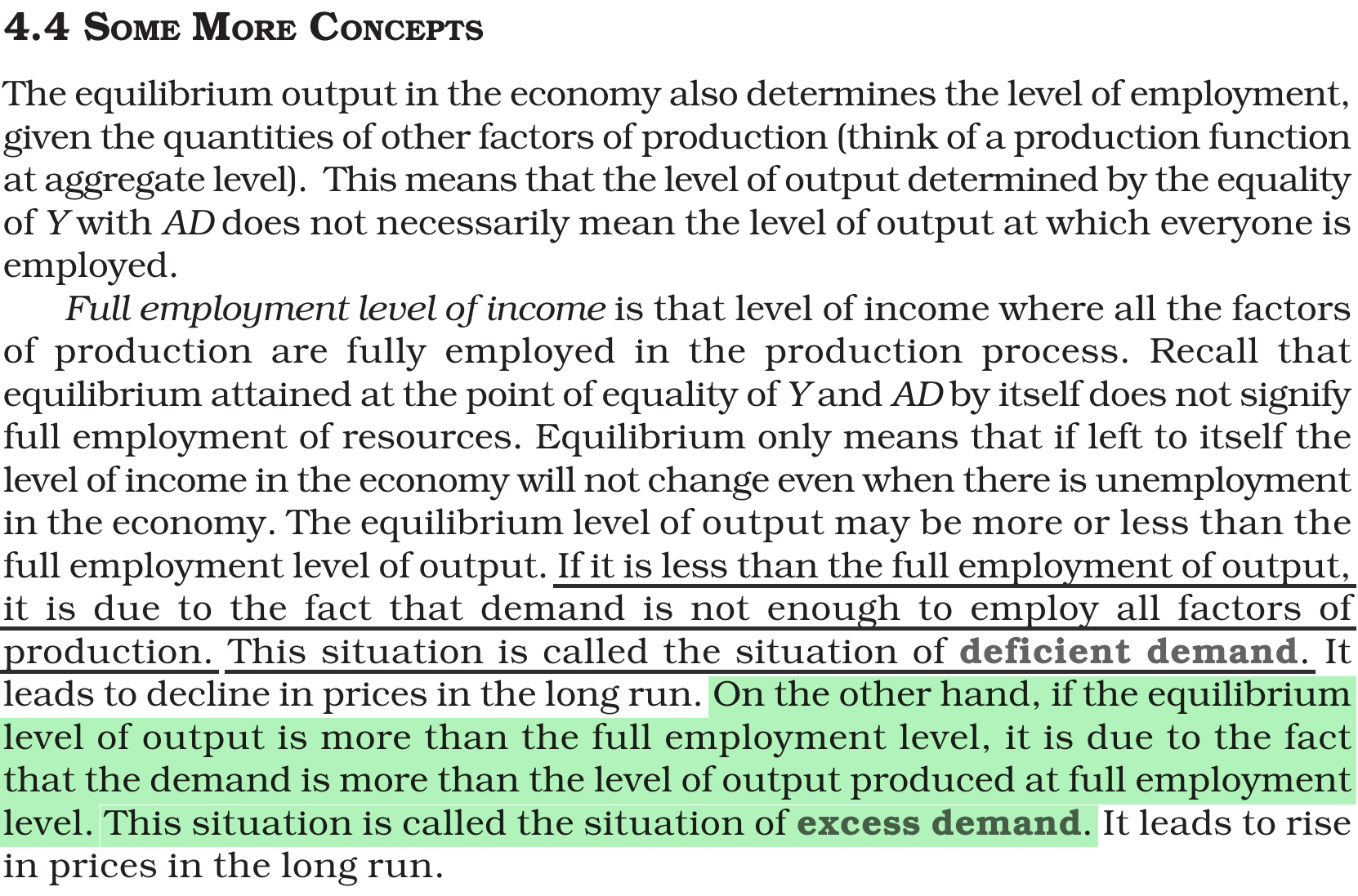
The correct answer is Option (1) → AD > AS at full employment level
Aggregate demand (AD) is the total demand in the economy, and aggregate supply (AS) is its output. Excess demand arises when AD is more than AS at the full employment level. At this level all the factors of production, such as labour and capital, are already at work. So output cannot rise to meet the extra demand, and prices rise in the long run.
Option (1) AD > AS at full employment level — Correct. Demand is more than the output that the economy can produce with all its factors at work.
Option (2) AD < AS at full employment level — Incorrect. Demand falls short of the full employment output. This is the opposite situation, deficient demand, which lowers prices in the long run.
Option (3) AD > AS at under employment level — Incorrect. Some factors are still idle at this level. So the extra demand can be met by producing more output.
Option (4) AD < AS at under employment level — Incorrect. Here demand is low and factors are also idle. Demand is too little, which is the reverse of an excess.
NCERT (2026-27): Introductory Macroeconomics — Chapter 4: Determination of Income and Employment
|