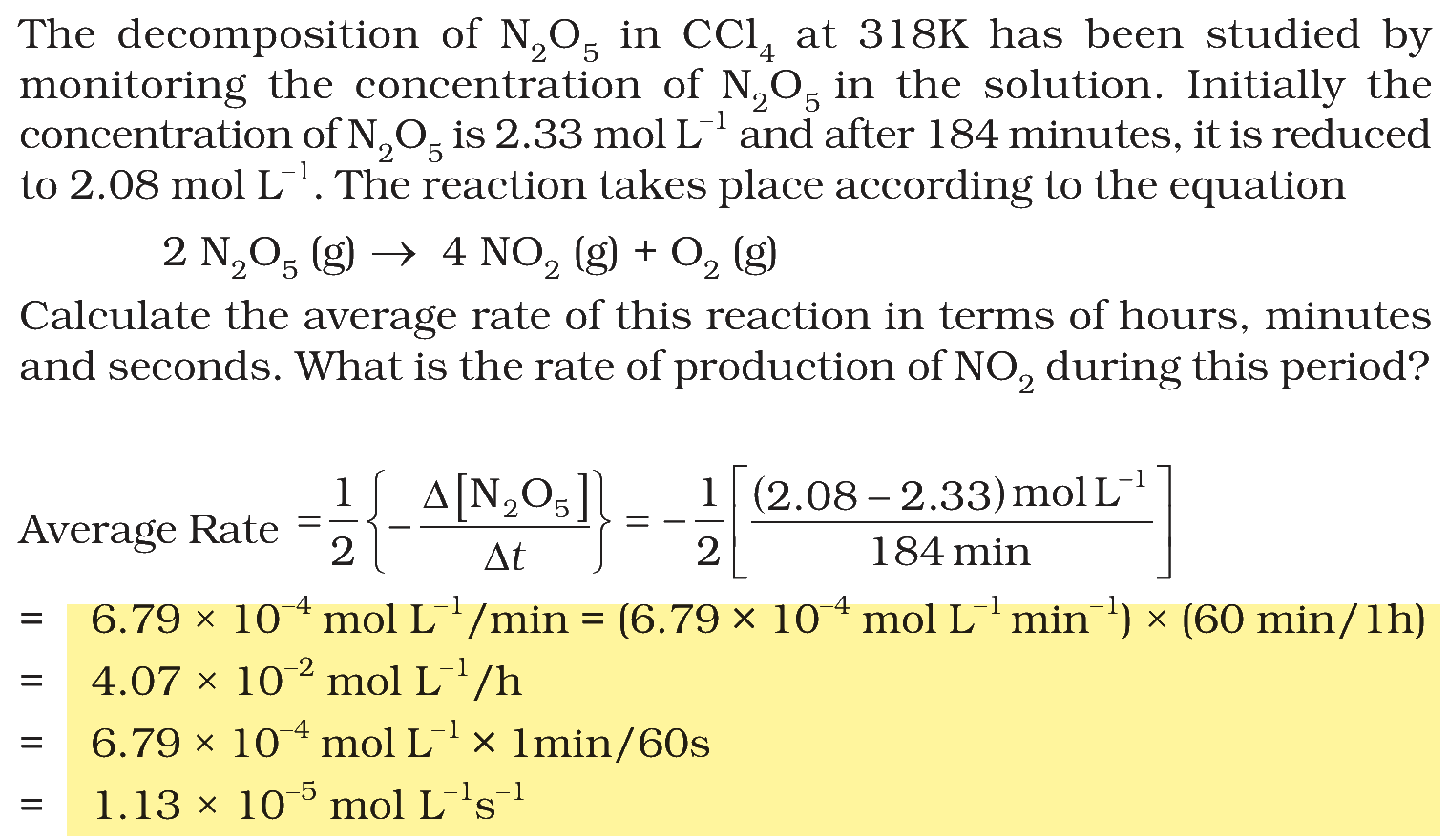
The decomposition of \( N_2O_5 \) in \( CCl_4 \) at 318K has been studied by monitoring the concentration of \( N_2O_5 \) in the solution. Initially, the concentration of \( N_2O_5 \) is 2.33 mol/L and after 184 minutes, it is reduced to 2.08 mol/ L. The reaction takes place according to the equation
\( 2\text{N}_2\text{O}_5(\text{g})\rightarrow4\text{NO}_2(\text{g})+\text{O}_2(\text{g}) \)
The average rate of this reaction in different units will be:
Answer & explanation
Correct answer: option 1
The correct answer is Option (1) → \(4.07\times10^{-2}\text{ mol L}^{-1}\text{ h}^{-1},6.79\times10^{-4}\text{ mol L}^{-1}\text{ min}^{-1},1.13\times10^{-5}\text{ mol L}^{-1}\text{ s}^{-1}\)
The rate of a reaction is the change in concentration of a reactant or product per unit time, divided by its stoichiometric coefficient, so that the same rate is obtained whichever species is followed. For a reactant the change is negative, so a minus sign is put in front. For \( \ce{2N2O5 -> 4NO2 + O2} \):
\( \displaystyle r_{av} = -\frac{1}{2}\,\frac{\Delta[\ce{N2O5}]}{\Delta t} \)
The data give \( \Delta[\ce{N2O5}] = 2.08 - 2.33 = -0.25\ \mathrm{mol\,L^{-1}} \) in \( \Delta t = 184\ \mathrm{min} \):
\( \displaystyle r_{av} = -\frac{1}{2} \times \frac{-0.25\ \mathrm{mol\,L^{-1}}}{184\ \mathrm{min}} = 6.79 \times 10^{-4}\ \mathrm{mol\,L^{-1}\,min^{-1}} \)
Converting the time unit: there are 60 min in an hour and 60 s in a minute.
\( \displaystyle 6.79 \times 10^{-4} \times 60 = 4.07 \times 10^{-2}\ \mathrm{mol\,L^{-1}\,h^{-1}} \)
\( \displaystyle \frac{6.79 \times 10^{-4}}{60} = 1.13 \times 10^{-5}\ \mathrm{mol\,L^{-1}\,s^{-1}} \)
So the average rate is \( 4.07\times10^{-2} \) mol L−1 h−1, \( 6.79\times10^{-4} \) mol L−1 min−1 and \( 1.13\times10^{-5} \) mol L−1 s−1.
Note: This question is from NCERT (2026-27). NTA sets numerical questions from NCERT too, so do not ignore NCERT while practising numericals.
NCERT (2026-27 edition):
Rate of a Chemical Reaction – …