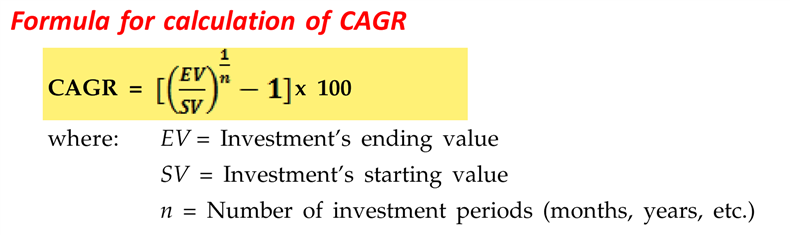
If CAGR stands for Compound Annual Growth Rate, F.V stands for final value of an investment, P.V stands for present value of an investment and n is the number of years then
Answer & explanation
Correct answer: option 1
The correct answer is Option (1) → \(CAGR =\left(\displaystyle\frac{F.V}{P.V}\right)^{\frac{1}{n}}-1\)
The CAGR is the constant yearly rate at which the present value would grow to the final value in n years, with compounding:
\(P.V\,(1 + CAGR)^n = F.V\)
\( \displaystyle 1 + CAGR = \left(\frac{F.V}{P.V}\right)^{\frac{1}{n}} \)
\( \displaystyle CAGR = \left(\frac{F.V}{P.V}\right)^{\frac{1}{n}} - 1 \)
CBSE Applied Mathematics (Class XII):
Compound Annual Growth Rate