
Match List-I has four graphs showing variation of opposition to flow of ac versus frequency with circuit characteristic in List-II.
| List-I | List-II |
(A) 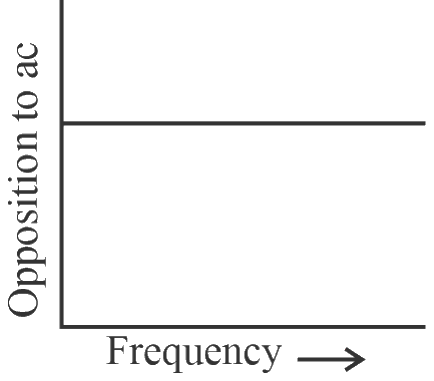 | (I) Impedance |
(B) 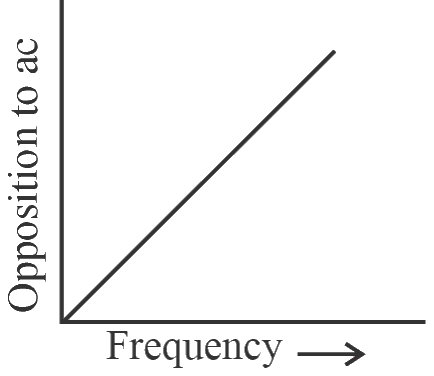 | (II) Capacitive reactance |
(C) 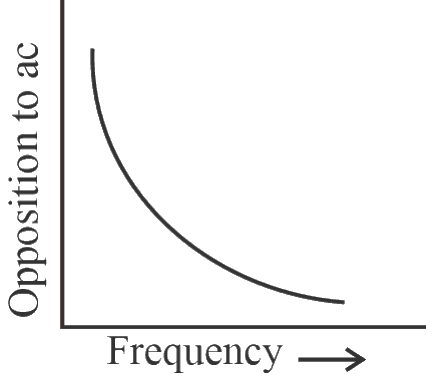 | (III) Inductive reactance |
(D) 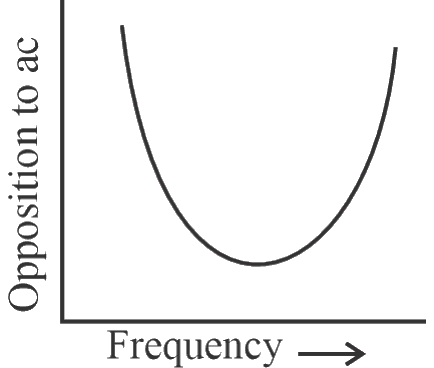 | (IV) Resistance |
Choose the correct answer from the options given below.
Answer & explanation
Correct answer: option 2
The correct answer is Option (2) → (A) - (IV), (B) - (III), (C) - (II), (D) - (I)
Each kind of opposition to ac depends on the frequency \( f \) in its own way.
(A) Horizontal line — this matches (IV) Resistance. A resistance \( R \) does not depend on frequency.
(B) Straight line through the origin — this matches (III) Inductive reactance. The reactance grows in proportion to frequency.
\( \displaystyle X_L = 2\pi f L \propto f \)
(C) Falling curve — this matches (II) Capacitive reactance. The reactance is inversely proportional to frequency.
\( \displaystyle X_C = \frac{1}{2\pi f C} \propto \frac{1}{f} \)
(D) U-shaped curve — this matches (I) Impedance. The impedance of a series LCR circuit is least (equal to \( R \)) at resonance, where \( X_L = X_C \), and rises on both sides.
\( \displaystyle Z = \sqrt{R^{2} + (X_L - X_C)^{2}} \)
NCERT (2026-27):
AC Voltage Applied to an Inductor – “… The inductive reactance is directly proportional to the inductance and to the frequency of the current.”
AC Voltage Applied to a Capacitor – “… The capacitive reactance limits the amplitude of the current in a purely capacitive circuit in the same way as the resistance limits the current in a purely resistive circuit. But it is inversely proportional to the frequency and the capacitance.”
Resonance – “… So if \( \omega \) is varied, then at a particular frequency \( \omega_0 \), \( X_c = X_L \), and the impedance is minimum \( \left(Z = \sqrt{R^2 + 0^2} = R\right) \). This frequency is called the resonant frequency:
\( \displaystyle X_c = X_L \quad \text{or} \quad \frac{1}{\omega_0 C} = \omega_0 L \quad \text{or} \quad \omega_0 = \frac{1}{\sqrt{LC}} \qquad (7.28) \)”