Two different sex chromosomes, designated as Z and W involved in sex determination are found in:
Answer & explanation
Correct answer: option 4
The correct answer is Option (4) → Birds
Option (1) Taenia — Incorrect. Taenia is the tapeworm. It is bisexual (hermaphrodite): one animal has both male and female organs. So it has no separate sexes to be fixed by sex chromosomes.
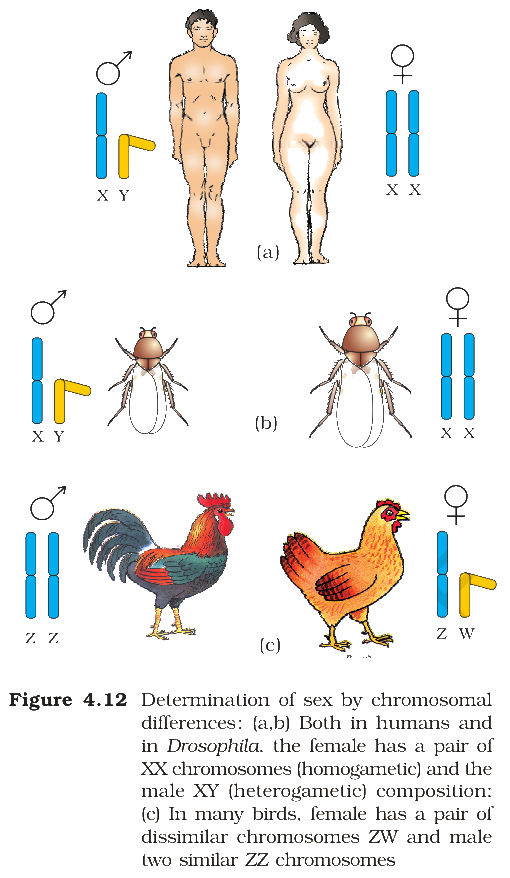
Option (2) Human — Incorrect. Humans have the XY type. The female is XX and the male is XY, so the male makes two kinds of sperm.
Option (3) Drosophila — Incorrect. The fruit fly also has the XY type of sex determination, the same as humans. Here too the male makes the two kinds of gametes.
Option (4) Birds — Correct. In birds it is the female that makes two kinds of gametes. This is called female heterogamety.
NCERT Extract:
Sex Determination – “… In the above description you have studied about two types of sex determining mechanisms, i.e., XO type and XY type. But in both cases males produce two different types of gametes, (a) either with or without X-chromosome or (b) some gametes with X-chromosome and some with Y-chromosome. Such types of sex determination mechanism is designated to be the example of male heterogamety. In some other organisms, e.g., birds, a different mechanism of sex determination is observed (Figure 4.12 c). In this case the total number of chromosome is same in both males and females. But two different types of gametes in terms of the sex chromosomes, are produced by females, i.e., female heterogamety. In order to have a distinction with the mechanism of sex determination described earlier, the two different sex chromosomes of a female bird has been designated to be the Z and W chromosomes. In these organisms the females have one Z and one W chromosome, whereas males have a pair of Z-chromosomes besides the autosomes.”