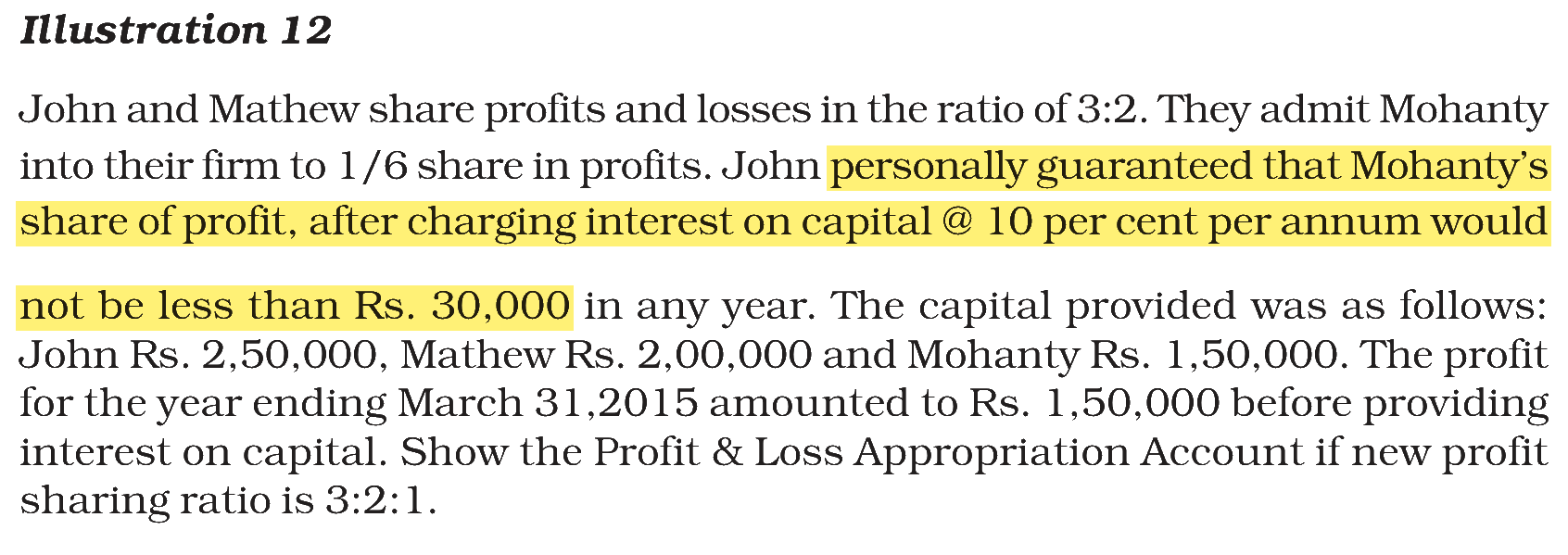
John and Mathew share profits and losses in the ratio of 3:2. They admit Mohanty into their firm for 1/6 share in profits. John personally guaranteed that Mohanty's share of profit, after charging interest on capital @ 10% per annum would not be less than Rs. 30,000 in any year. The capital provided was as follows: John Rs. 2,50,000, Mathew Rs. 2,00,000 and Mohanty Rs. 1,50,000. The profit for the year ending March 31, 2025 amounted to be Rs. 1,50,000 before providing interest on capital. New profit sharing ratio is 3:2:1. Based on this, choose the correct statements from the options given below:
(A) John's share of profit is Rs. 30,000
(B) Mathew's share of profit is Rs. 30,000
(C) Mohanty's share of profit is Rs. 30,000
(D) John's share of profit is Rs. 60,000
Answer & explanation
Correct answer: option 1
The correct answer is Option (1) → (A), (B) and (C) only
When a partner is guaranteed a minimum profit and his share falls short, the partner who gave the guarantee bears the deficiency. Interest on capital is charged first, and only the balance is divided.
Interest on capital @ 10%:
John = Rs. 2,50,000 × 10% = Rs. 25,000
Mathew = Rs. 2,00,000 × 10% = Rs. 20,000
Mohanty = Rs. 1,50,000 × 10% = Rs. 15,000
Profit left = Rs. 1,50,000 − Rs. 60,000 = Rs. 90,000
Shares in 3:2:1, then the guarantee:
John = Rs. 90,000 × 3/6 = Rs. 45,000
Mathew = Rs. 90,000 × 2/6 = Rs. 30,000
Mohanty = Rs. 90,000 × 1/6 = Rs. 15,000
Mohanty’s deficiency = Rs. 30,000 − Rs. 15,000 = Rs. 15,000, borne by John
John = Rs. 45,000 − Rs. 15,000 = Rs. 30,000
Mohanty = Rs. 15,000 + Rs. 15,000 = Rs. 30,000
(A) John’s share of profit is Rs. 30,000 Correct. His Rs. 45,000 less the Rs. 15,000 he makes good.
(B) Mathew’s share of profit is Rs. 30,000 Correct. His 2/6 of Rs. 90,000; the guarantee does not touch him, since only John gave it.
(C) Mohanty’s share of profit is Rs. 30,000 Correct. His own Rs. 15,000 plus Rs. 15,000 from John.
(D) John’s share of profit is Rs. 60,000 Incorrect. John ends with Rs. 30,000; Rs. 60,000 is the total interest on capital of all three partners.
Note: This question is from NCERT (2026-27). NTA sets numerical questions from NCERT too, so do not ignore NCERT while practising numericals.
NCERT (2026-27 edition):
|