If the foreign exchange rate changes from $1 = ₹80 to $1 = ₹83, what does this indicate for the Indian currency ?
Answer & explanation
Correct answer: option 2
The correct answer is Option (2) → Depreciation of currency
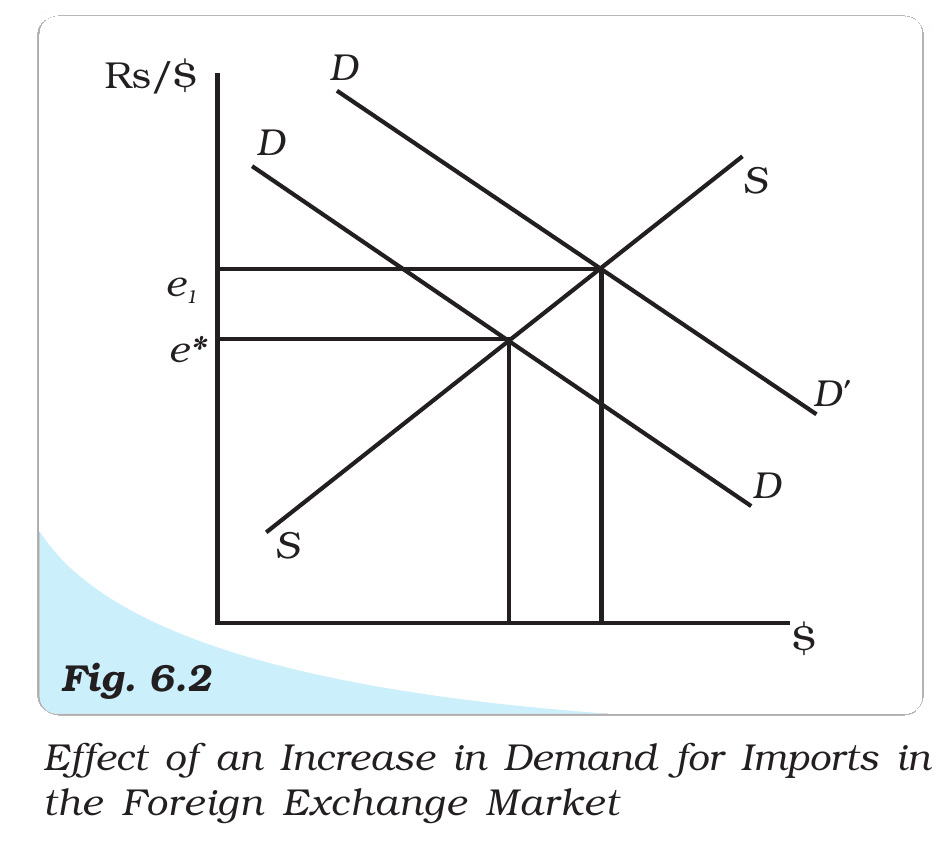
A dollar first cost ₹80 and now costs ₹83. More rupees are needed to buy one dollar, so the rupee has lost value against the dollar.
Option (1) Appreciation of currency — Incorrect. Under appreciation, the rupee gains value, so fewer rupees buy a dollar.
Option (2) Depreciation of currency — Correct. A rise in the price of foreign exchange makes the domestic currency cheaper. This is depreciation.
Option (3) Devaluation — Incorrect. This is a rise in the exchange rate by government action in a fixed exchange rate system. The question mentions no government action and no fixed rate.
Option (4) Revaluation — Incorrect. This is the opposite of devaluation. Government action lowers the exchange rate in a fixed system and makes the domestic currency dearer.
NCERT (2026-27): “Flexible Exchange Rate … The initial exchange rate e0 = 50, which means that we need to exchange Rs 50 for one dollar. At the new equilibrium, the exchange rate becomes e1 = 70, which means that we need to pay more rupees for a dollar now (i.e., Rs 70). It indicates that the value of rupees in terms of dollars has fallen and value of dollar in terms of rupees has risen. Increase in exchange rate implies that the price of foreign currency (dollar) in terms of domestic currency (rupees) has increased. This is called Depreciation of domestic currency (rupees) in terms of foreign currency (dollars). Similarly, in a flexible exchange rate regime, when the price of domestic currency (rupees) in terms of foreign currency (dollars) increases, it is called Appreciation of the domestic currency (rupees) in terms of foreign currency (dollars).… Fixed Exchange Rates … In a fixed exchange rate system, when some government action increases the exchange rate (thereby, making domestic currency cheaper) is called Devaluation. On the other hand, a Revaluation is said to occur, when the Government decreases the exchange rate (thereby, making domestic currency costlier) in a fixed exchange rate system.”
|