
Which one of the following represents the correct feasible region determined by the following constraints of an LPP?
\(x + y \ge 10,\ 2x + 2y \le 25,\ x \ge 0,\ y \ge 0\)
Answer & explanation
Correct answer: option 3
The correct answer is Option (3) →
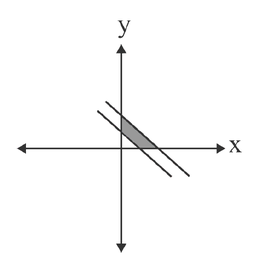
Dividing the second constraint by 2:
\( \displaystyle x + y \le \frac{25}{2} = 12.5 \)
So the boundary lines are x + y = 10, through (10, 0) and (0, 10), and x + y = 12.5, through (12.5, 0) and (0, 12.5). Both have slope −1, so they are parallel lines.
The origin test gives the side of each line:
\(x + y \ge 10\): \(0 \ge 10\) is false, so the region is on the side away from the origin
\(x + y \le 12.5\): \(0 \le 12.5\) is true, so the region is on the origin’s side
Together with \(x \ge 0,\ y \ge 0\), the feasible region is the strip between the two parallel lines in the first quadrant, a trapezium with corners (10, 0), (12.5, 0), (0, 12.5) and (0, 10). Option (3) shades exactly this strip.
Why the other options are incorrect
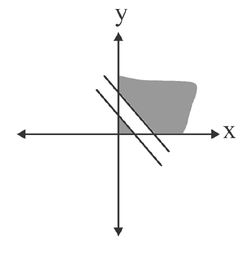
Option (1) — Incorrect. It shades the first-quadrant parts outside the strip, beyond the outer line and next to the origin, which is where \(x + y \le 10\) or \(x + y \ge 12.5\). Both inequalities are reversed.
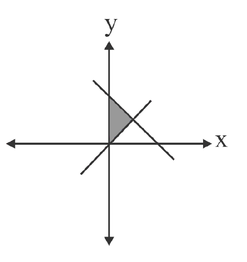
Option (2) — Incorrect. One of its lines passes through the origin with a positive slope, so its two lines are not the parallel lines x + y = 10 and x + y = 12.5.
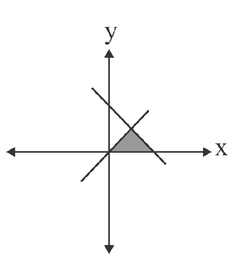
Option (4) — Incorrect. Like Option (2), it uses a line through the origin with a positive slope, not the two given parallel lines.