
The reaction of R-CO-NH2 with bromine and KOH gives RNH2 as the end product. Which one of the following is the intermediate product formed in this reaction?
Answer & explanation
Correct answer: option 3
The correct answer is option 3. R-N=C=O.
The reaction of an amide (R-CO-NH₂) with bromine (\(Br_2\)) and potassium hydroxide (\(KOH\)) is known as the Hofmann degradation reaction. This reaction typically involves the conversion of an amide to a primary amine with the loss of one carbon atom.
The steps involved in this reaction are:
Formation of an Intermediate: The amide reacts with bromine and a strong base like potassium hydroxide to form an intermediate known as N-haloamide.
Formation of an Isocyanate Intermediate: The N-haloamide decomposes to form an isocyanate intermediate.
Hydrolysis of Isocyanate: The isocyanate intermediate is then hydrolyzed to form the primary amine and carbon dioxide.
Reaction Mechanism: Let us take an example to understand the mechanism:
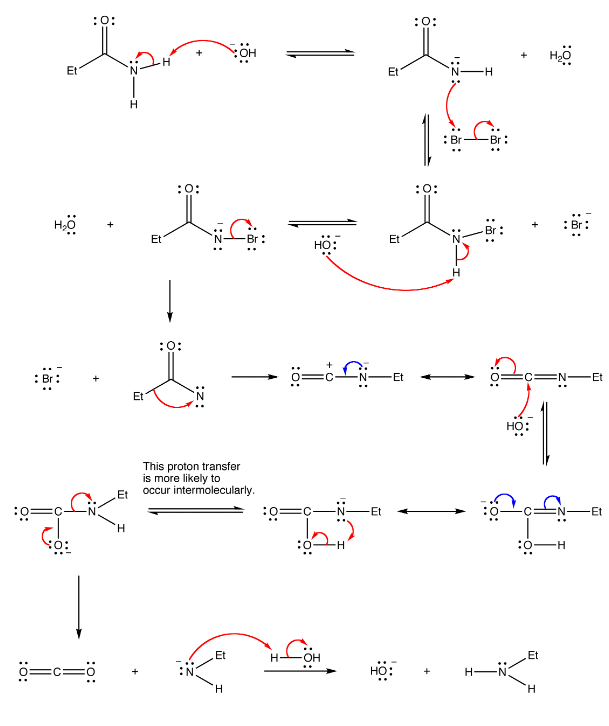
Intermediates in the Reaction:
R-CO-NH-Br: This is not typically a stable intermediate in the Hofmann degradation reaction; instead, it's the N-haloamide.
R-NH-Br: This is not an intermediate in the Hofmann degradation reaction.
R-N=C=O: This is the isocyanate intermediate, which is formed after the N-haloamide decomposes and is then hydrolyzed to give the primary amine.
R-CO-NBr₂: This is the N-haloamide intermediate, which reacts to form the isocyanate.
The intermediate product formed in this reaction is R-N=C=O (isocyanate), which is an important intermediate in the Hofmann degradation process.
Therefore, the correct answer is 3. R-N=C=O.