
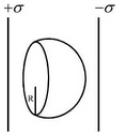
A hemisphere of radius R is placed between two uniformly charged-thin infinite sheets of charge density \( +\sigma \) and \( -\sigma \). Flux through the curved surface of the hemisphere:
Answer & explanation
Correct answer: option 2
The correct answer is Option (2) → \( \displaystyle\frac{\sigma}{\varepsilon_0}(\pi R^{2}) \)
Two parallel sheets of charge density \( +\sigma \) and \( -\sigma \) produce a uniform field between them, from the positive to the negative sheet and perpendicular to the sheets. Each sheet gives \( \frac{\sigma}{2\varepsilon_0} \) and the two add up between the sheets.
\( \displaystyle E = \frac{\sigma}{2\varepsilon_0} + \frac{\sigma}{2\varepsilon_0} = \frac{\sigma}{\varepsilon_0} \)
The curved surface and the flat circular face together make a closed surface that encloses no charge, so by Gauss's law the net flux through it is zero. The field is perpendicular to the flat face, whose area is \( \pi R^{2} \). The field enters the hemisphere through the flat face and leaves through the curved surface, so the flux out of the curved surface equals the flux that enters through the flat face.
\( \displaystyle \phi_{\mathrm{curved}} = E\times\pi R^{2} = \frac{\sigma}{\varepsilon_0}(\pi R^{2}) \)