
CUETMOCK
  • Pricing
  • Mentors
Log inStart freeStart free mocks→

First test, then trust

Try a free CUET mock test.

Join 5,00,000+ students who rehearsed exam day on the exact NTA screen before sitting CUET. On the web and on Android.

Start free mocks →Get the Android app
CUETMOCK

India's #1 CUET Mock Test Platform. Original NCERT-based questions on the exact NTA exam screen — trusted by 5,00,000+ students since CUET 2022.

Get it onGoogle PlayScan to download the CUETMOCK app

Mock tests

  • CUET mock test series
  • Browse all papers
  • Commerce mocks
  • Humanities (Arts) mocks
  • Science mocks
  • Languages & GAT mocks
  • Free practice questions
  • Pricing

Resources

  • CUET exam guide
  • CUET syllabus
  • Universities accepting CUET
  • Expert blogs
  • News & notifications
  • Webinars & counselling
  • CUET score calculator
  • How we estimate your rank
  • FAQs

Company

  • About us
  • Our leadership & team
  • Our toppers
  • Mentors
  • For schools
  • Contact us
  • Terms
  • Privacy
  • Refund policy

Talk to us

+91 7696 6630 56info@cuetmock.comWhatsApp us

Our other platforms

  • JEE Mock — For IIT-JEE aspirants
  • NEET Mock — For NEET aspirants

Newsletter

Exam updates, study material and offers — no spam.

© 2026 NYC Ventures Pvt. Ltd.

701-702, Royal Business Park, Zirakpur, Punjab - 140603

  • Terms of use
  • Privacy policy
  • Refund policy
  • Contact us

iCUETMOCK is an independent preparation platform, not affiliated with the National Testing Agency (NTA). Always check exam details on the official NTA website.

  • Home
  • Mock tests
  • CUET guide
  • Pricing
  • Log in
Home/Practice questions/Chemistry
ChemistryPhysical: Chemical Kinetics

The correct expression of the rate of the reaction according to the c…

The correct expression of the rate of the reaction according to the collision theory is

Answer & explanation+

Correct answer: option 2

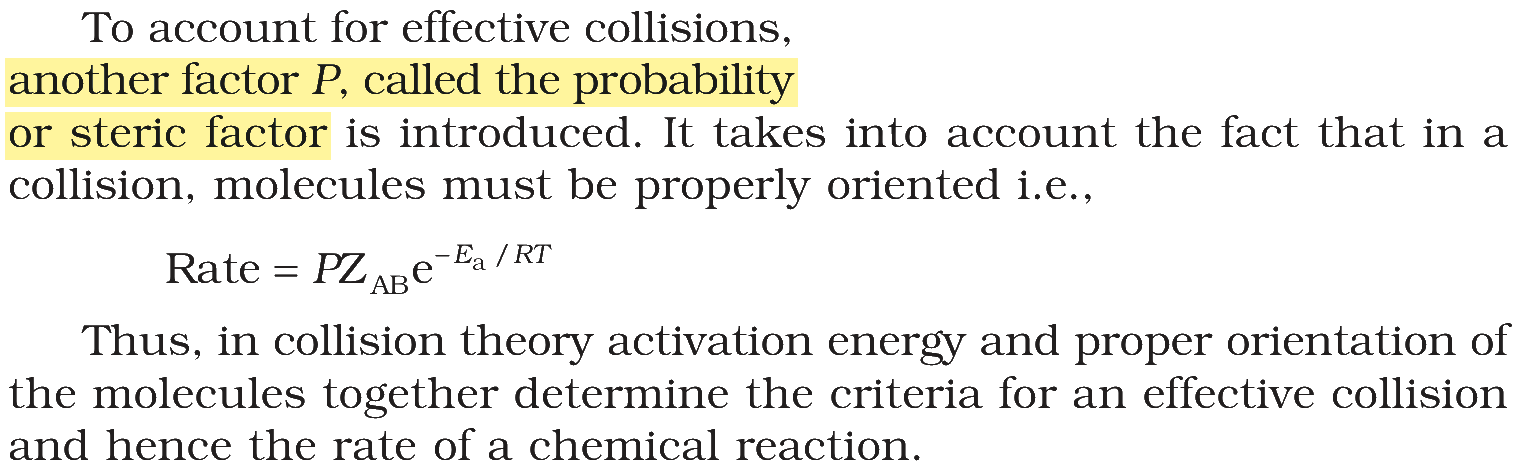
The correct answer is Option (2) → \(PZ_{AB} e^{-Ea/RT}\)

The collision theory treats molecules as hard spheres that react only when they collide. Three things decide the rate of a bimolecular reaction \( \ce{A + B -> products} \):

  • the collision frequency \( Z_{AB} \), the number of collisions per second per unit volume;

  • the fraction of collisions with energy equal to or greater than the activation energy, \( e^{-E_a/RT} \);

  • the steric factor P, for proper orientation.

Putting the three together:

    \( \displaystyle \text{Rate} = P\,Z_{AB}\,e^{-E_a/RT} \)

Why the other options are incorrect

  • Option (1) \(Z_{AB} e^{-Ea/RT}\) — Incorrect. This counts every sufficiently energetic collision as effective and ignores orientation. It works for atoms and simple molecules but overestimates the rate for complex molecules.

  • Option (3) \(\frac{-Ea}{RT}\) — Incorrect. This is only the exponent, a pure number; it is not a rate.

  • Option (4) \(Pe^{-Ea/RT}\) — Incorrect. This leaves out the collision frequency; without collisions there is no reaction, so \( Z_{AB} \) must appear.

NCERT (2026-27 edition):
Collision Theory of Chemical Reactions – …
Textbook extract

Advertisement

Practise more on Physical: Chemical Kinetics

Chapter-wise mocks on the real NTA exam screen, with solutions and your rank. Your first mocks are free.

Start free mocks →

Advertisement

Next questions

  1. Which one of the following continents has the highest highway density in the world?Geography · Fundamentals of Human Geography: Transport and Communication
  2. Which of the following are the most primitive non-vascular plants?General Aptitude Test · General Knowledge
  3. By which method of the sangha would this matter now be settled?History · Ancient India: Thinkers, Beliefs and Buildings
  4. If A= […] and B is a square matrix of order 3, then |AB| is equal to:Maths. Section B1 · Determinants
  5. Which step completes an entry and moves the pointer to the cell to the right in an excel sheet?Accountancy Part C · Spreadsheet
  6. What is the uppermost layer over the earth's surface called?General Aptitude Test · General Knowledge
  7. Arrange the following in the increasing order of melting point. (i) NH3 (ii) PH3 (iii) AsH3 (iv) SbH3Chemistry · Inorganic: P Block Elements
  8. How much should be added to each term of 5:9 so that it becomes 3:5?General Aptitude Test · Numerical Ability
  9. Consider the following statements about the stages of group formation:(A) In the forming stage, there is a great deal of uncertainty about…Psychology · Social Influence and Group Processes
  10. Select the correct indirect form of the given sentence. He said, “I will go to Indonesia tomorrow".English · Direct/indirect