Arrange the following concept emerges in context of consumer equilibrium.
(A) Transfer his expenditure from Good Y to Good X.
(B) Sacrifice more of Good Y to gain Good X.
(C) Till, Marginal Rate of Substitution (MRSxy) = Market Rate of Exchange.
(D) Suppose, Marginal Rate of Substitution (MRSxy) > Market Rate of Exchange.
Choose the correct answer from the options given below:
Answer & explanation
Correct answer: option 2
The correct answer is Option (2) → (D), (B), (A), (C)
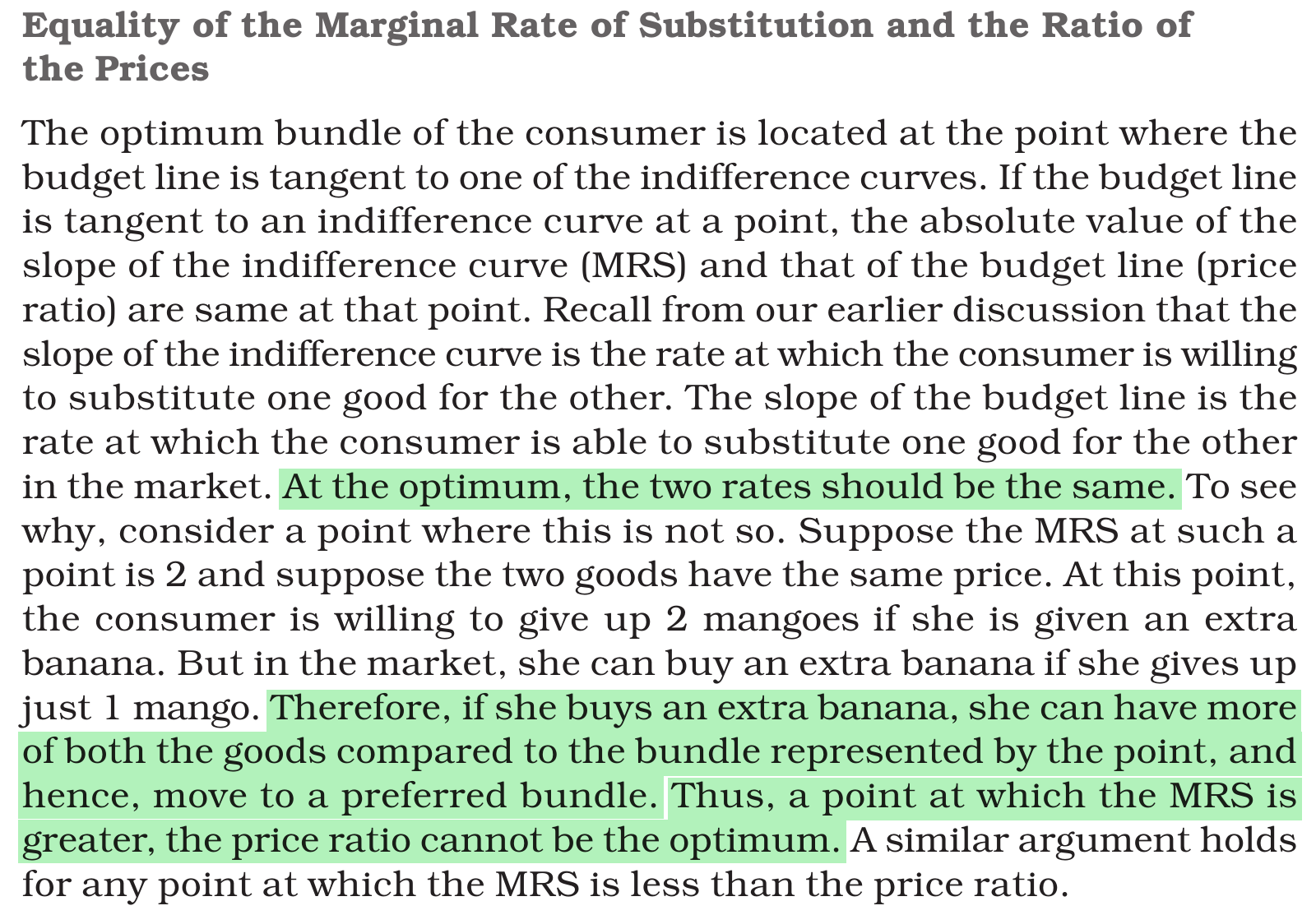
The Marginal Rate of Substitution (MRSxy) is how much of Good Y the consumer will give up for one more unit of Good X. The Market Rate of Exchange is the rate at which the market lets the goods be exchanged, that is, the price ratio. The consumer is in equilibrium only when the two are equal:
(D) Suppose, Marginal Rate of Substitution (MRSxy) > Market Rate of Exchange. — This is the starting point. The consumer is willing to give up more of Y than the market asks for one more X.
(B) Sacrifice more of Good Y to gain Good X. — The market gives X for less Y than the consumer is ready to pay. So giving up Y for X makes the consumer better off.
(A) Transfer his expenditure from Good Y to Good X. — The consumer now spends less on Y and more on X.
(C) Till, Marginal Rate of Substitution (MRSxy) = Market Rate of Exchange. — With more X and less Y, the MRS keeps falling. The transfer stops when the two rates are equal, and this is consumer equilibrium.
NCERT (2026-27): Introductory Microeconomics — Chapter 2: Theory of Consumer Behaviour
|