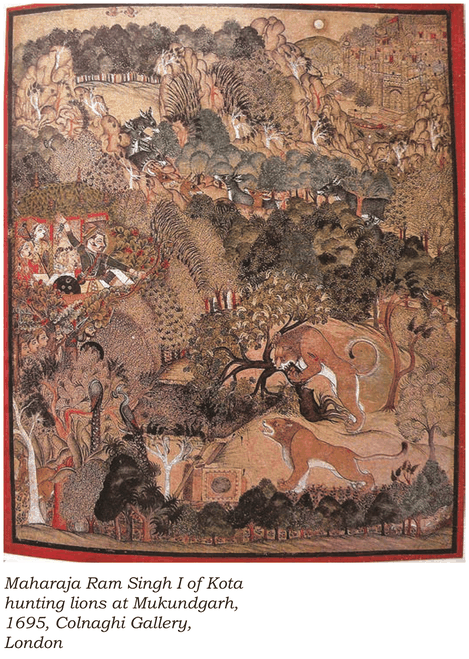
Rajasthani courts recorded their painting in inscriptions and court scenes. Consider the following statements:
(A) Inscriptions behind Marwar paintings do not reveal much information regarding the painting until the nineteenth century.
(B) Sawai Ishwari Singh of Jaipur got his hunts and elephant fights painted.
(C) The painting of Maharaja Ram Singh I hunting lions at Mukundgarh belongs to the Bundi School.
(D) In Marwar, a trend for documentary painting through portraiture started under the patronage of Man Singh.
Choose the correct answer from the options given below:
Answer & explanation
Correct answer: option 1
The correct answer is Option (1) → (A) and (B) only
(A) Inscriptions behind Marwar paintings do not reveal much information regarding the painting until the nineteenth century. — Correct. Before then, dates, artists’ names and places are rarely inscribed on Marwar paintings.
(B) Sawai Ishwari Singh of Jaipur got his hunts and elephant fights painted. — Correct. Apart from religious and literary texts, Ishwari Singh got his leisure pursuits painted.
(C) The painting of Maharaja Ram Singh I hunting lions at Mukundgarh belongs to the Bundi School. — Incorrect. Ram Singh I was a ruler of Kota, and the painting is a Kota hunting scene. Kota had its own school after it separated from Bundi.
(D) In Marwar, a trend for documentary painting through portraiture started under the patronage of Man Singh. — Incorrect. This trend started under Maharaja Jaswant Singh around 1640. Man Singh (1803–1843) belongs to the last innovative phase of Jodhpur painting.
Note: This topic was not named in the CUET 2026 syllabus, but it was part of the NCERT chapter. In 2025 and 2026, NTA also asked questions on topics in NCERT that the CUET syllabus did not name. So our mocks have questions from every part of the NCERT chapter, to give you enough practice. Read the whole chapter, not only the sub-topics named in the syllabus.
NCERT (2026-27): “Jodhpur School of Painting …A productive period of painting was ushered in by Maharaja Jaswant Singh (1638–1678) in the mid–seventeenth century. A trend for documentary painting through portraiture and depiction of court life started under his patronage around 1640 and enjoyed prominence till the advent of photography in the nineteenth century when it substituted painting for recording events. …Inscriptions behind Marwar paintings do not reveal much information regarding the painting until the nineteenth century. Seldom, dates are inscribed, and even more rarely, the names of artists and place of painting find a mention.” “Jaipur School of Painting …Sawai Ishwari Singh (1743–1750) extended the same patronage to art. Apart from religious and literary texts, he got scenes of his leisure pursuits painted, such as elephant rides, boar and tiger hunts, elephant fights, and so on.”
|