Arrange the following electromagnetic waves in their increasing order of energy.
(A) Gamma rays
(B) X-rays
(C) Microwaves
(D) Infrared waves
(E) Ultraviolet rays
Choose the correct answer from the options given below:
Answer & explanation
Correct answer: option 3
The correct answer is Option (3) → (C), (D), (E), (B), (A)
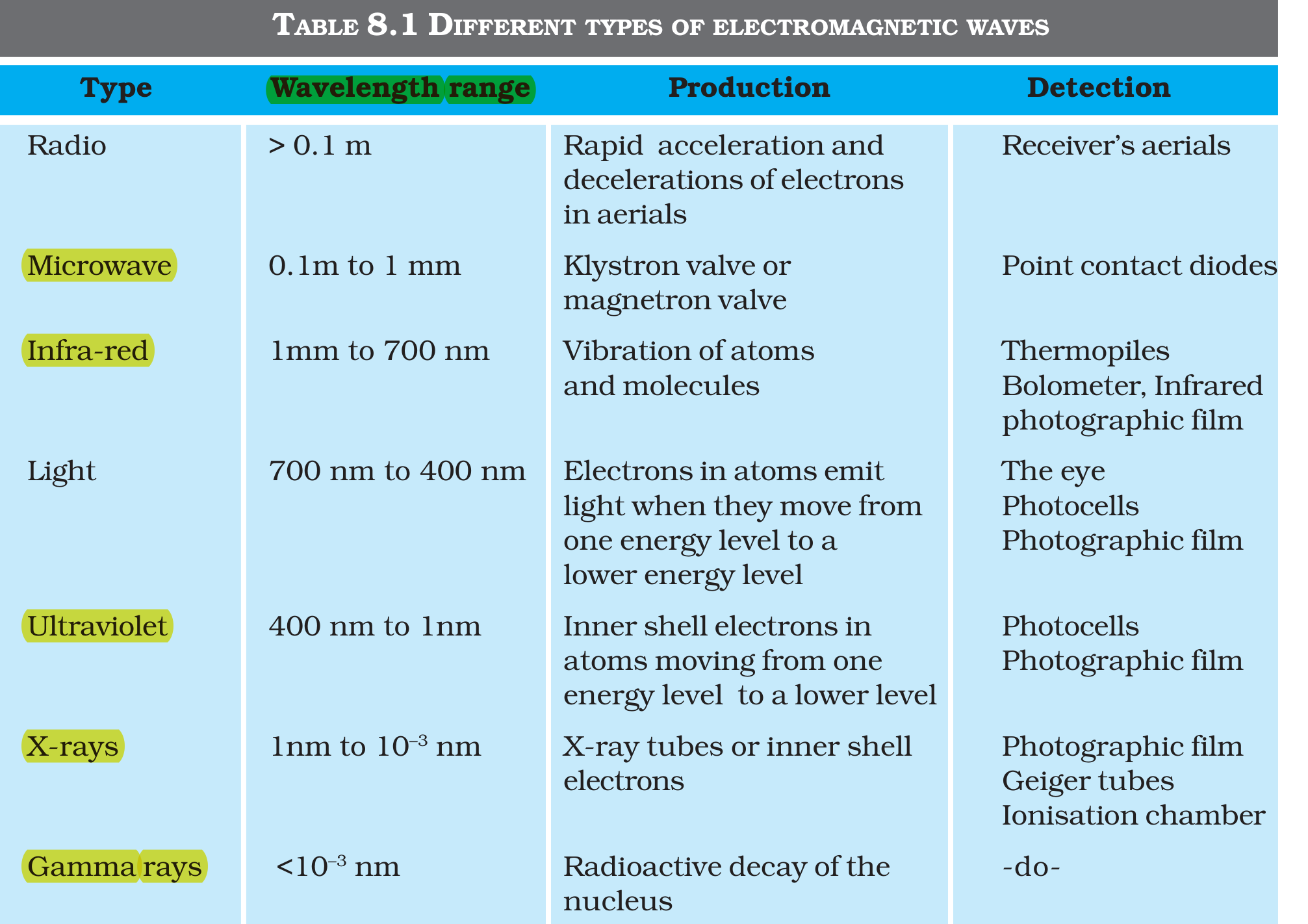
The energy of a photon is \( E = hc/\lambda \), so the shorter the wavelength, the greater the energy. The approximate wavelength ranges of the waves are:
\( (C)\ \text{Microwaves: } 1\,\mathrm{mm} \text{ to } 1\,\mathrm{m} \)
\( (D)\ \text{Infrared waves: } 700\,\mathrm{nm} \text{ to } 1\,\mathrm{mm} \)
\( (E)\ \text{Ultraviolet rays: } 1\,\mathrm{nm} \text{ to } 400\,\mathrm{nm} \)
\( (B)\ \text{X-rays: } 10^{-3}\,\mathrm{nm} \text{ to } 1\,\mathrm{nm} \)
\( (A)\ \text{Gamma rays: below } 10^{-3}\,\mathrm{nm} \)
Arranged from the longest wavelength (least energy) to the shortest wavelength (most energy):
\( \displaystyle \text{Microwaves} \lt \text{Infrared} \lt \text{Ultraviolet} \lt \text{X-rays} \lt \text{Gamma rays} \)
So the increasing order of energy is (C), (D), (E), (B), (A).
Note: A similar question was also asked in CUET (UG) 2025 on 28-05-2025 (Slot 2).
NCERT (2026-27):
Gamma Rays – …