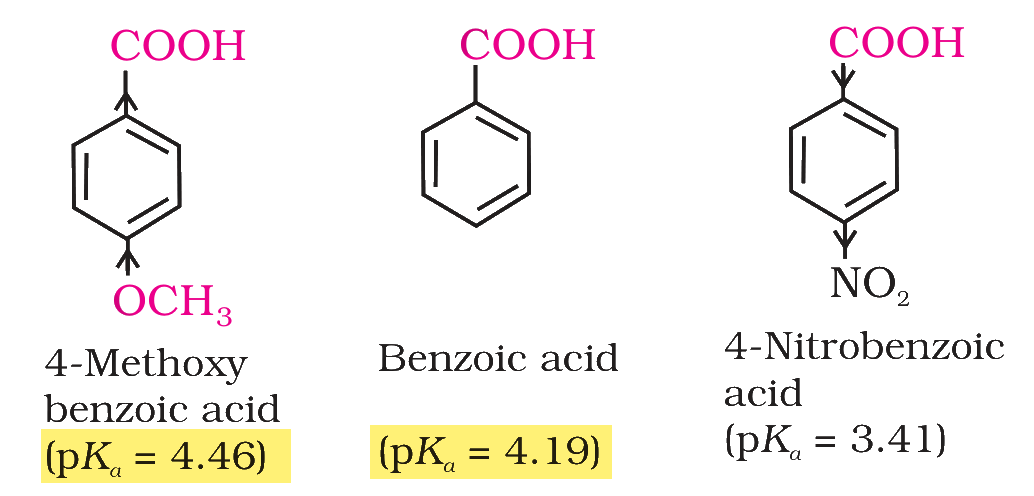
Assertion (A): 4-Methoxybenzoic acid is a weaker acid than benzoic acid.
Reason (R): The carboxylate ion is stabilised by two equivalent resonance structures in which the negative charge is on the more electronegative oxygen atom.
In the light of the above statements, choose the correct answer from the options given below:
Answer & explanation
Correct answer: option 2
The correct answer is Option (2) → Both (A) and (R) are true but (R) is not the correct explanation of (A).
The strength of a carboxylic acid depends on how stable its conjugate base, the carboxylate anion, is. A group on the benzene ring can make this anion more or less stable and so change the strength of the acid.
Assertion (A): 4-Methoxybenzoic acid is a weaker acid than benzoic acid. — True. Its pKa is 4.46, higher than that of benzoic acid (4.19); a higher pKa means a weaker acid.
Reason (R): The carboxylate ion is stabilised by two equivalent resonance structures in which the negative charge is on the more electronegative oxygen atom. — True. This is why carboxylic acids are more acidic than phenols, whose conjugate base has non-equivalent resonance structures.
Why R does not explain A?
Both acids give carboxylate ions with the same two equivalent resonance structures, so R cannot account for the difference between them.
The correct reason is that the methoxy group is electron donating; it destabilises the carboxylate anion and so decreases the acidity.
NCERT (2026-27 edition):
8.9.1 Reactions Involving Cleavage of O–H Bond – “The conjugate base of carboxylic acid, a carboxylate ion, is stabilised by two equivalent resonance structures in which the negative charge is at the more electronegative oxygen atom.”
“Conversely, electron donating groups decrease the acidity by destabilising the conjugate base.”
“The presence of electron withdrawing group on the phenyl of aromatic carboxylic acid increases their acidity while electron donating groups decrease their acidity.”