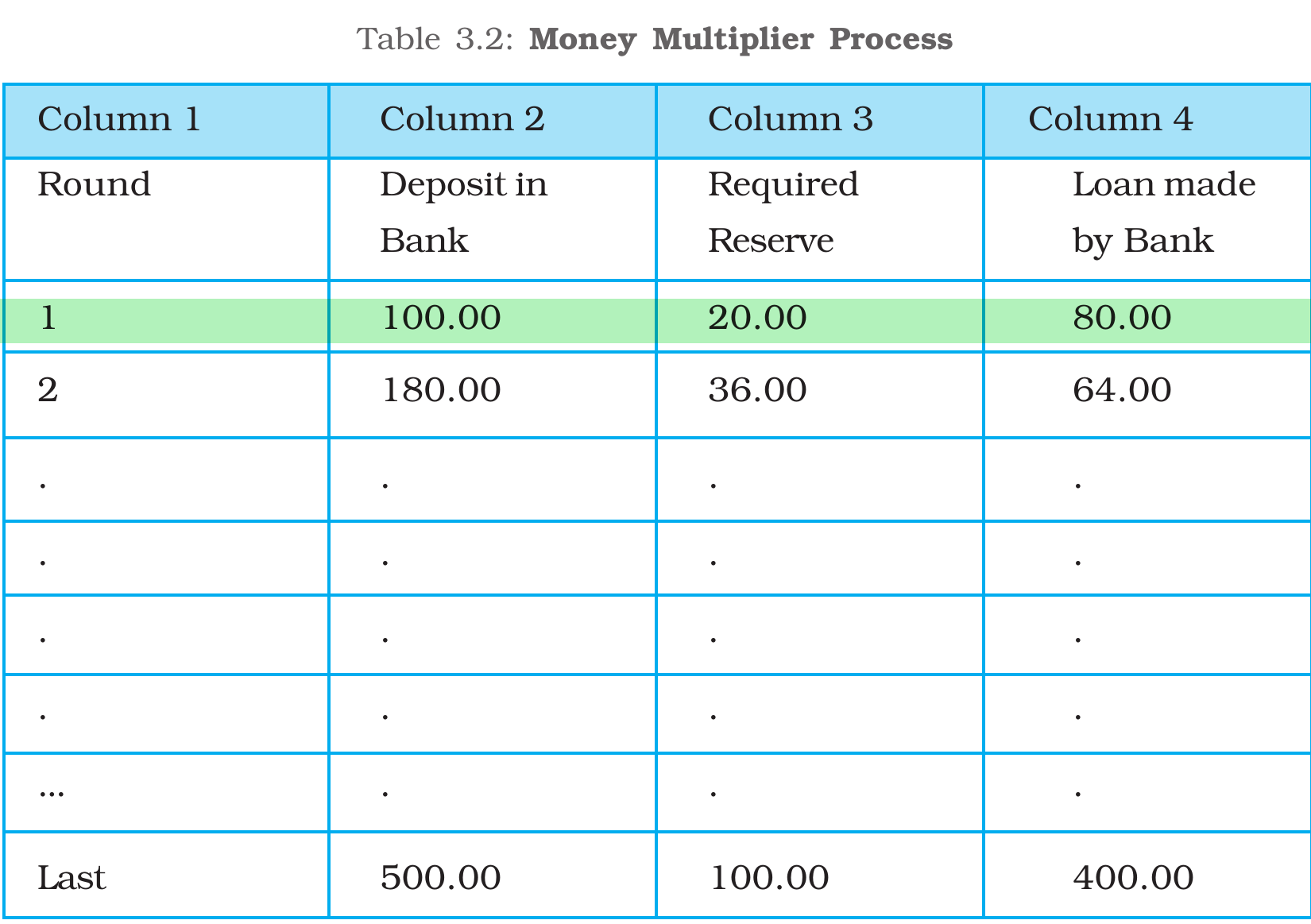
Money Multiplier Process
| Column 1 | Column 2 | Column 3 | Column 4 |
| Round | Deposit in Bank | Required Reserve | Loan made by Bank |
| 1 | 100.00 | 20.00 | 80.00 |
| 2 | 180.00 | 36.00 | 64.00 |
| - | - | - | - |
| - | - | - | - |
| - | - | - | - |
| - | - | - | - |
| - | - | - | - |
| Last | 500.00 | 100.00 | 400.00 |
The first column lists each round. The second column depicts the total deposits with the Bank at the beginning of each round. Twenty percent of these deposits need to be deposited with the RBI as required reserves (column 3). What the Bank lends in each round gets added to the deposits with the bank in the next round. Column 4 indicates the Loans made by the banks.
How much is the initial deposit in the above Money Multiplier process table ?
Answer & explanation
Correct answer: option 3
The correct answer is Option (3) → 100.00
The initial deposit is the deposit in the first round, before any loan has been made. Round 1 of Column 2 shows 100.00.
Out of this, 20.00 goes into required reserves and 80.00 is lent. Those 80.00 come back as deposits, which is why Round 2 shows 180.00.
NCERT (2026-27): “3.3.2 Limits to Credit Creation and Money Multiplier … Let us assume that our bank starts with a deposit of Rs 100 made by Leela. The reserve ratio is 20 per cent. Thus our bank has Rs 80 (100 – 20) to lend and the bank lends out Rs 80 to Jaspal Kaur, which shows up in the bank’s deposits in the next round as liabilities, making a total of Rs 180 as deposits. Now our bank is required to keep 20 per cent of 180 i.e. Rs 36 as cash reserves. Recall that our bank had started with Rs 100 as cash. Since it is required to keep only Rs 36 as reserves, it can lend Rs 64 again (100 – 36 = 64). The bank lends out Rs 64 to Junaid. This in turn shows up in the bank as deposits. The process keeps repeating itself till all the required reserves become Rs 100. The required reserves will be Rs 100 only when the total deposits become Rs 500. This is because for deposits of Rs 500, cash reserves would have to be Rs 100 (20 per cent of 500 = 100).…”
|