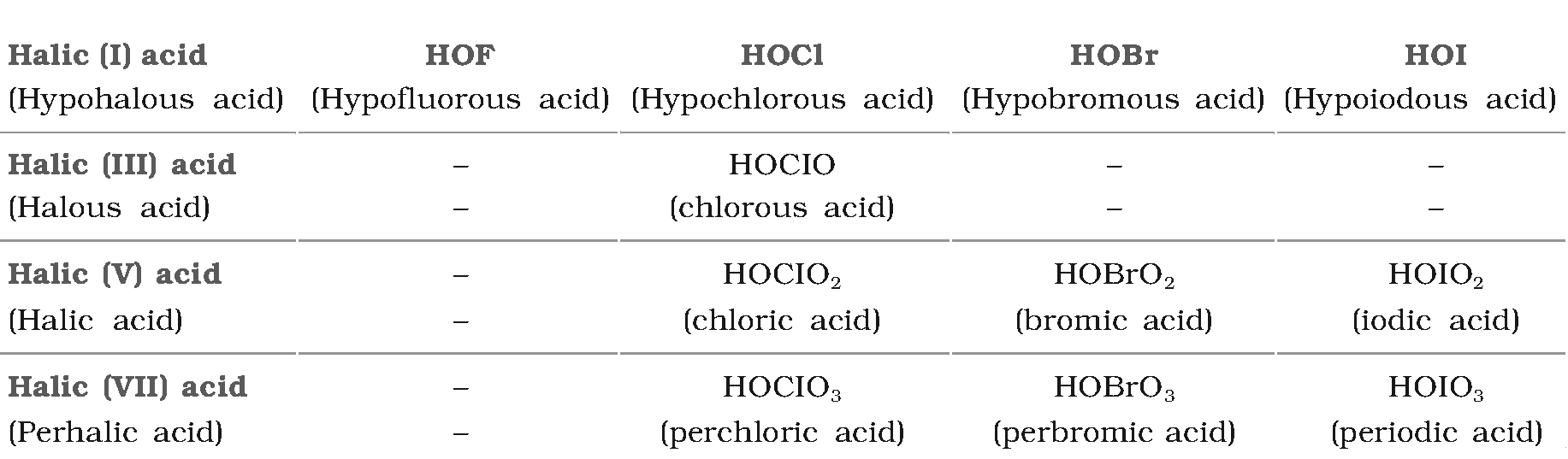
Match List I with List II
| List I | List II |
| A. Chloric acid | I. \(HOCl\) |
| B. Chlorous acid | II. \(HClO_2\) |
| C. Hypochlorous acid | III. \(HClO_3\) |
| D. Perchloric acid | IV. \(HClO_4\) |
Choose the correct answer from the options given below:
Answer & explanation
Correct answer: option 3
The correct answer is Option (3) → A-III, B-II, C-I, D-IV
The oxoacids of chlorine are named by the oxidation state of Cl: hypo-…-ous (+1) < -ous (+3) < -ic (+5) < per-…-ic (+7). With H = +1 and O = −2, the oxidation state of Cl follows from the formula.
(A) Chloric acid — This matches (III) HClO3. 1 + x + 3(−2) = 0, so x = +5.
(B) Chlorous acid — This matches (II) HClO2. 1 + x + 2(−2) = 0, so x = +3.
(C) Hypochlorous acid — This matches (I) HOCl. 1 + x + (−2) = 0, so x = +1.
(D) Perchloric acid — This matches (IV) HClO4. 1 + x + 4(−2) = 0, so x = +7.
Note: This question is from the pre-rationalised NCERT book (2022-23). The topic is not there in the latest NCERT book (2026-27), and it is also out of the CUET 2026 syllabus.
NCERT (Pre-rationalised edition, 2022-23):
Oxoacids of Halogens – …