Find marginal propensity to save if consumption function is \( C= 40 + 0.8y \).
Answer & explanation
Correct answer: option 2
The correct answer is Option (2) → 0.2
Given:
Consumption function: C = 40 + 0.8Y
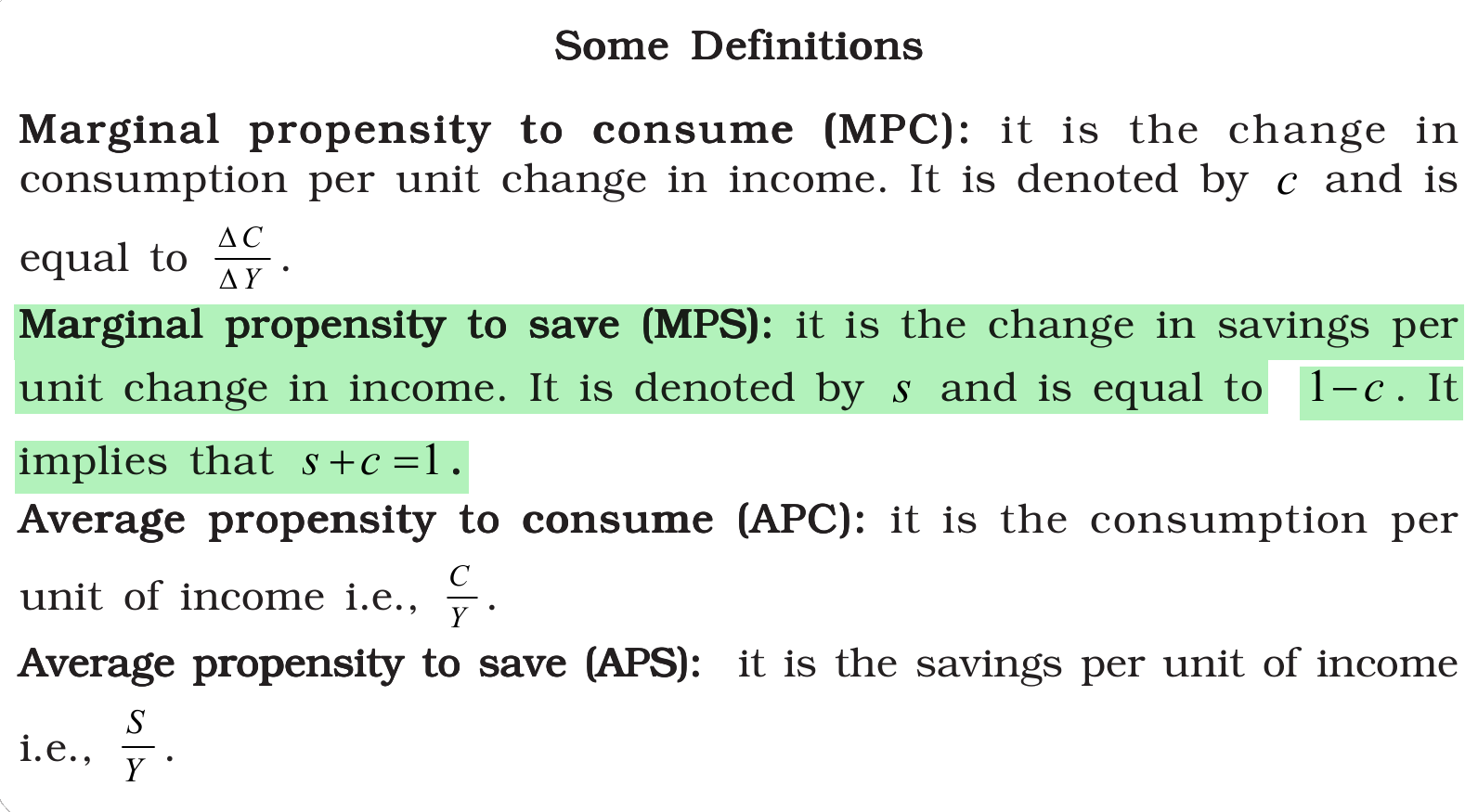
In C = 40 + 0.8Y, the number that multiplies income, 0.8, is the marginal propensity to consume (MPC). Every extra rupee of income is either consumed or saved, so MPC + MPS = 1, where MPS is the marginal propensity to save.
MPC = 0.8
MPS = 1 − MPC
MPS = 1 − 0.8 = 0.2
The 40 is autonomous consumption, the part spent even at zero income; it does not enter the MPS.
NCERT (2026-27): “4.1.1. Consumption The most important determinant of consumption demand is household income. A consumption function describes the relation between consumption and income. The simplest consumption function assumes that consumption changes at a constant rate as income changes.… The induced component of consumption, cY shows the dependence of consumption on income. When income rises by Re 1. induced consumption rises by MPC i.e. c or the marginal propensity to consume. It may be explained as a rate of change of consumption as income changes.…”
|