
CUETMOCK
  • Pricing
  • Mentors
Log inStart freeStart free mocks→

First test, then trust

Try a free CUET mock test.

Join 5,00,000+ students who rehearsed exam day on the exact NTA screen before sitting CUET. On the web and on Android.

Start free mocks →Get the Android app
CUETMOCK

India's #1 CUET Mock Test Platform. Original NCERT-based questions on the exact NTA exam screen — trusted by 5,00,000+ students since CUET 2022.

Get it onGoogle PlayScan to download the CUETMOCK app

Mock tests

  • CUET mock test series
  • Browse all papers
  • Commerce mocks
  • Humanities (Arts) mocks
  • Science mocks
  • Languages & GAT mocks
  • Free practice questions
  • Pricing

Resources

  • CUET exam guide
  • CUET syllabus
  • Universities accepting CUET
  • Expert blogs
  • News & notifications
  • Webinars & counselling
  • CUET score calculator
  • How we estimate your rank
  • FAQs

Company

  • About us
  • Our leadership & team
  • Our toppers
  • Mentors
  • For schools
  • Contact us
  • Terms
  • Privacy
  • Refund policy

Talk to us

+91 7696 6630 56info@cuetmock.comWhatsApp us

Our other platforms

  • JEE Mock — For IIT-JEE aspirants
  • NEET Mock — For NEET aspirants

Newsletter

Exam updates, study material and offers — no spam.

© 2026 NYC Ventures Pvt. Ltd.

701-702, Royal Business Park, Zirakpur, Punjab - 140603

  • Terms of use
  • Privacy policy
  • Refund policy
  • Contact us

iCUETMOCK is an independent preparation platform, not affiliated with the National Testing Agency (NTA). Always check exam details on the official NTA website.

  • Home
  • Mock tests
  • CUET guide
  • Pricing
  • Log in
Home/Practice questions/Chemistry
ChemistryOrganic: Aldehydes, Ketones and Carboxylic Acids

Which of the following reagents will not convert Toluene into Benzald…

Which of the following reagents will not convert Toluene into Benzaldehyde?

Answer & explanation+

Correct answer: option 4

The correct answer is Option (4) → \(CO/HCl\) in presence of \(AlCl_3\)

Toluene can be turned into benzaldehyde only by oxidising its methyl group to –CHO, either directly with a chromium(VI) reagent that stops at the aldehyde stage, or through a dichloride that is then hydrolysed. The Gattermann-Koch reaction does something different: carbon monoxide and HCl with anhydrous \( \ce{AlCl3} \) put a new –CHO group on the benzene ring:

    \( \displaystyle \ce{C6H6} \xrightarrow[\text{anhyd. }\ce{AlCl3}/\ce{CuCl}]{\ce{CO},\ \ce{HCl}} \ce{C6H5CHO} \)

With toluene the methyl group stays and the ring is formylated, mainly at the para position, so the product is 4-methylbenzaldehyde, not benzaldehyde:

    \( \displaystyle \ce{CH3C6H5} \xrightarrow[\text{anhyd. }\ce{AlCl3}]{\ce{CO},\ \ce{HCl}} p\text{-}\ce{CH3C6H4CHO} \)

  • Option (1) \(CrO_2Cl_2\) — Converts toluene into benzaldehyde. In the Etard reaction chromyl chloride oxidises the methyl group to a chromium complex, which is hydrolysed to benzaldehyde:

        \( \displaystyle \ce{C6H5CH3} \xrightarrow[\ce{H3O+}]{\ce{CrO2Cl2},\ \ce{CS2}} \ce{C6H5CHO} \)

  • Option (2) \(CrO_3\) — Converts toluene into benzaldehyde. Chromic oxide in acetic anhydride gives benzylidene diacetate, which aqueous acid hydrolyses to benzaldehyde; the diacetate protects the aldehyde from further oxidation:

        \( \displaystyle \ce{C6H5CH3} \xrightarrow[\text{273-283 K}]{\ce{CrO3},\ \ce{(CH3CO)2O}} \ce{C6H5CH(OCOCH3)2} \xrightarrow{\ce{H3O+}} \ce{C6H5CHO} \)

  • Option (3) \(Cl_2/\text{light}, H_2O\) — Converts toluene into benzaldehyde. Side-chain chlorination gives benzal chloride, which on hydrolysis gives benzaldehyde (the commercial method):

        \( \displaystyle \ce{C6H5CH3} \xrightarrow{\ce{Cl2}/h\nu} \ce{C6H5CHCl2} \xrightarrow[\text{373 K}]{\ce{H2O}} \ce{C6H5CHO} \)

  • Option (4) \( CO/HCl \) in presence of \( AlCl_3 \) — Does not convert toluene into benzaldehyde (gives 4-methylbenzaldehyde). The Gattermann-Koch reaction formylates the ring and leaves the methyl group in place.

NCERT (2026-27 edition):
By Gattermann–Koch Reaction
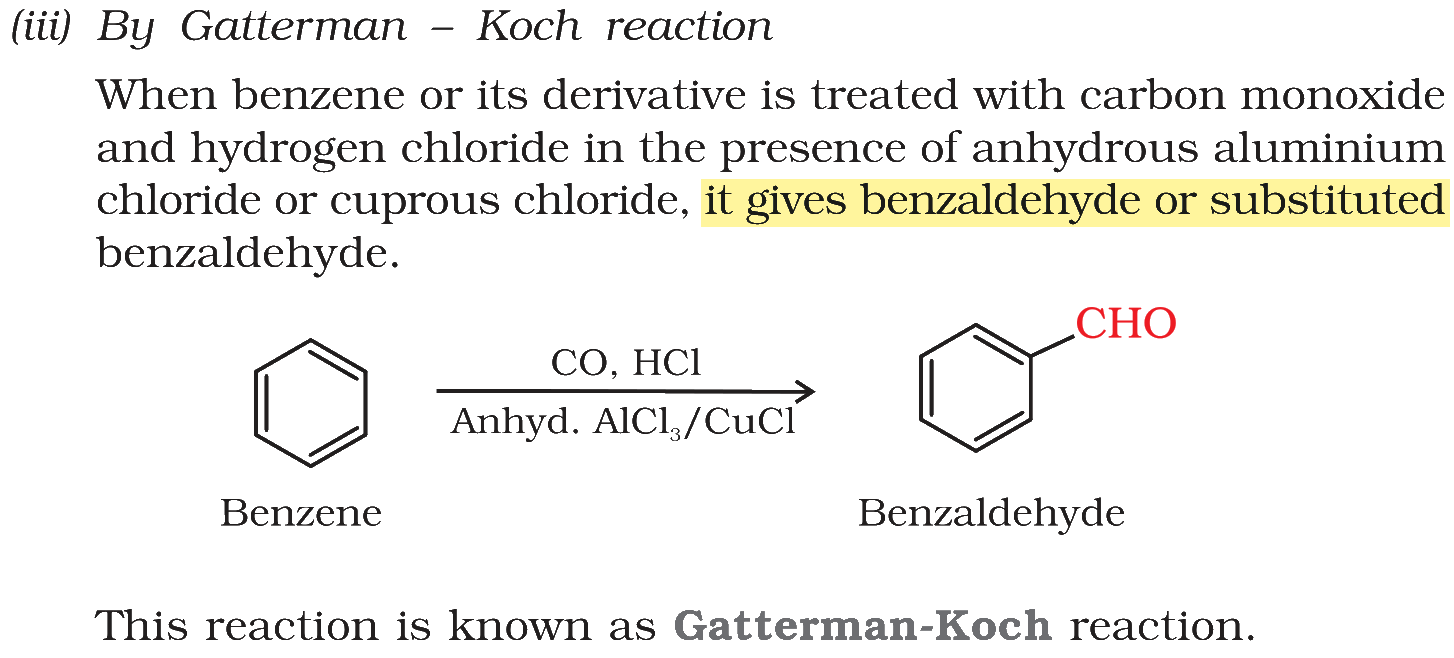
Textbook extract

By Oxidation of Methylbenzene – “Strong oxidising agents oxidise toluene and its derivatives to benzoic acids. However, it is possible to stop the oxidation at the aldehyde stage with suitable reagents that convert the methyl group to an intermediate that is difficult to oxidise further. The following methods are used for this purpose. (a) Use of chromyl chloride (\( \ce{CrO2Cl2} \)): Chromyl chloride oxidises methyl group to a chromium complex, which on hydrolysis gives corresponding benzaldehyde. … (b) Use of chromic oxide (\( \ce{CrO3} \)): Toluene or substituted toluene is converted to benzylidene diacetate on treating with chromic oxide in acetic anhydride. The benzylidene diacetate can be hydrolysed to corresponding benzaldehyde with aqueous acid.”

Advertisement

Practise more on Organic: Aldehydes, Ketones and Carboxylic Acids

Chapter-wise mocks on the real NTA exam screen, with solutions and your rank. Your first mocks are free.

Start free mocks →

Advertisement

Next questions

  1. In the given figure, how many printed books are coloured.General Aptitude Test · Verbal Reasoning
  2. Which of the following statements is/are true about the Ruhr Region?Geography · Fundamentals of Human Geography: Secondary Activities
  3. What is paid to a partner by the firm if the partner is paid a fixed amount as remuneration and expenses of realisation at the time of diss…Accountancy Part A · Dissolution of Partnership Firm
  4. How does an understanding of someone's personality help in dealing with them?Psychology · Self and Personality
  5. The following histogram shows the height of players of a basketball team of a school. How many players have height less than 141 cm?General Aptitude Test · Quantitative Reasoning
  6. Select the word which means the same as the group of words given. Steal or misappropriate moneyEnglish · One Word
  7. Select the most appropriate option to fill in the blanks. Police used ____ evidence to convict a victim who was innocent.English · Fill Blanks
  8. Completion of the first meiotic division of the primary oocytes takes place -Biology · Human Reproduction
  9. If 8 + 3x lt |8 + 3x|, x ∈ R , then x lies in :Applied Maths. Section B2 · Numbers, Quantification and Numerical Applications
  10. Find the value of ( (sin 27°)/(cos 63°) )2 + ( (cos 63°)/(sin 27°) )2General Aptitude Test · Quantitative Reasoning