Answer the questions from the passage-
XYZ Ltd. purchased assets worth Rs 3,00,000 from Blue Prints Ltd., and took over its liabilities of Rs 20,000 for a purchase consideration of Rs 3,15,000. XYZ Ltd., paid the purchase consideration by issuing 12% debentures of Rs 100 each at a premium of 5%.
Which situation is not true about Issue of Debentures?
Answer & explanation
Correct answer: option 4
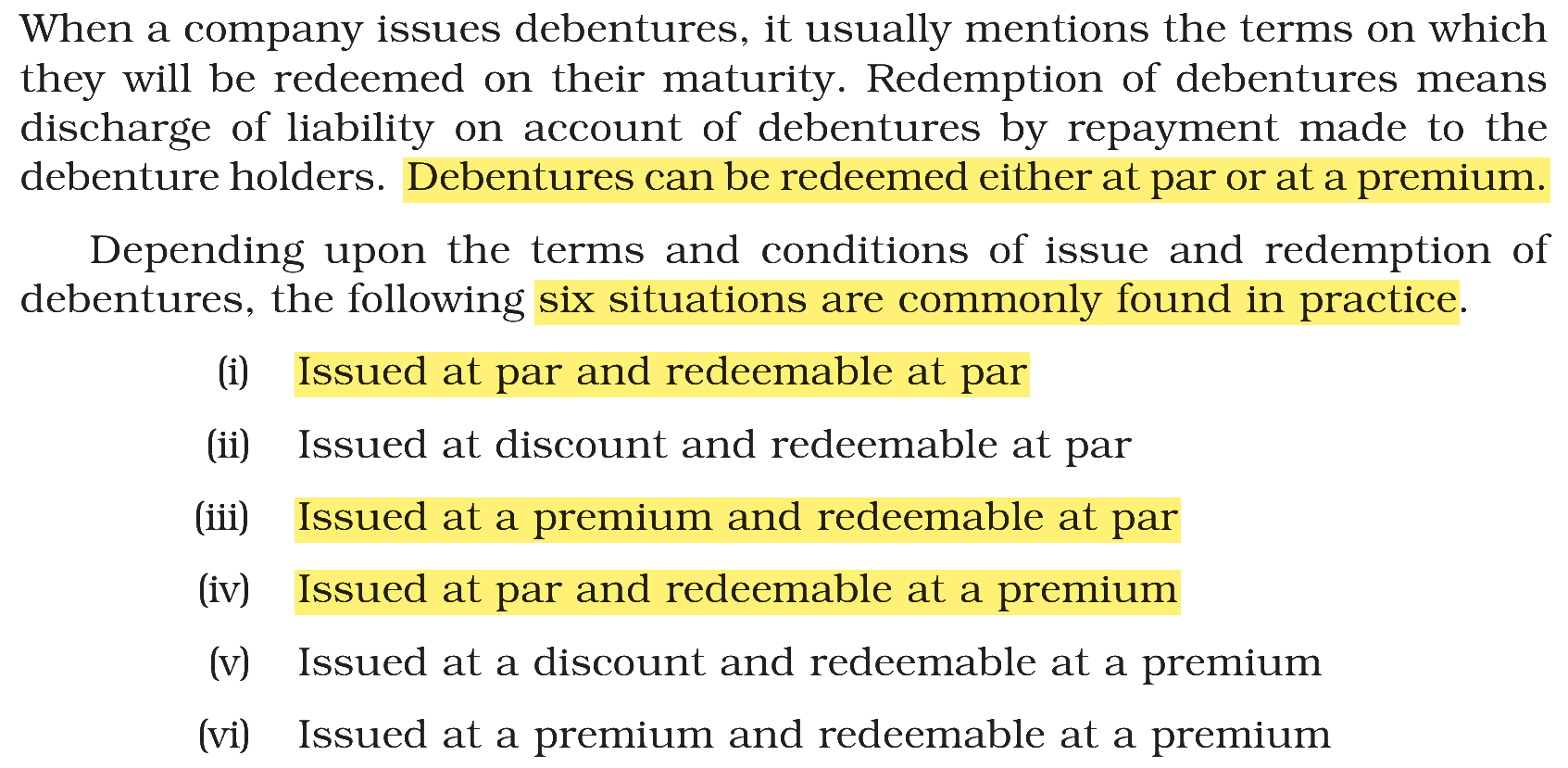
The correct answer is Option (4) → Issued at a discount and redeemable at a discount
The terms of a debenture issue say two things: the price at which the debenture is issued (par, premium or discount) and the amount at which it will be redeemed (par or premium). Redemption is the repayment of a loan, so the company always repays at least the face value; it never repays less than it borrowed on paper. That is why every recognised combination ends in “redeemable at par” or “redeemable at a premium”, and none ends in “redeemable at a discount”.
Option (1) Issued at par and redeemable at par — One of the six recognised situations. The simplest case: the holder pays the face value and gets the face value back.
Option (2) Issued at a premium and redeemable at par — One of the six recognised situations. The premium received is credited to Securities Premium Reserve, and only the face value is repaid.
Option (3) Issued at par and redeemable at a premium — One of the six recognised situations. The premium payable on redemption is a future liability, debited to Loss on Issue of Debentures Account at the time of issue.
NCERT (2026-27 edition):
|