
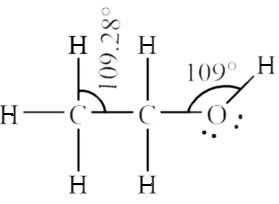
In alcohols, C-O-H bond angle is
Answer & explanation
Correct answer: option 1
The correct answer is Option (1) → Less than the tetrahedral bond angle (109° 28')
Alcohols contain the hydroxyl group (–OH) attached to a carbon atom. The oxygen atom in alcohols is sp³ hybridised.
In sp³ hybridisation, the ideal bond angle is 109° 28', which corresponds to a tetrahedral arrangement of electron pairs. However, the actual bond angle depends on the repulsion between lone pairs and bond pairs.
In alcohols, oxygen has:
Two bond pairs (O–C and O–H)
Two lone pairs
Thus, there are four electron pairs around oxygen, giving a tetrahedral electron pair geometry.
Lone pairs occupy more space than bonding pairs and exert stronger repulsion. The order of repulsion is:
Lone pair – Lone pair > Lone pair – Bond pair > Bond pair – Bond pair
Because of the two lone pairs present on oxygen, they repel the bonding pairs more strongly and compress the bond angle between O–C and O–H bonds.
Therefore, the C–O–H bond angle becomes slightly smaller than the ideal tetrahedral angle (109° 28').
Option-wise Explanation
Option 1: Less than the tetrahedral bond angle (109° 28')
This is correct because oxygen contains two lone pairs, which exert stronger repulsion than bonding pairs and reduce the C–O–H bond angle below the ideal tetrahedral value.
Option 2: Higher than the tetrahedral bond angle (109° 28')
This is incorrect because lone pairs compress bond angles rather than increase them.
Option 3: Exactly equal to tetrahedral bond angle i.e. 109° 28'
This is incorrect. The exact tetrahedral angle occurs only when there are four bond pairs and no lone pairs, such as in methane (CH₄).
Option 4: Exactly equal to 90°
This is incorrect because 90° bond angles are associated with octahedral or square planar geometries, not with sp³ hybridised oxygen in alcohols.