
The following describes the interaction between populations of two distinct species. They could be beneficial, detrimental or neutral (neither harm nor benefit) to one of the species or both. Assigning a ‘+’ sign for beneficial interaction, ‘-’ sign for detrimental and 0 for neutral interaction, let us look at all the possible outcomes of interspecific interactions. Choose the correct option.
Answer & explanation
Correct answer: option 1
The correct answer is Option (1) → A=(-), B=(0), C=(-)
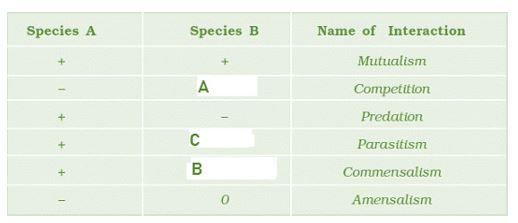
Interactions between two species are marked ‘+’ for benefit, ‘–’ for harm and 0 for neither. In the table the sign of species B is left blank in three rows (A, B and C); each blank is read from what happens to the second species.
A (Competition) — species B gets (–). In competition both species lose, so B is harmed just like A.
B (Commensalism) — species B gets (0). One species benefits and the other is neither benefited nor harmed, as with the orchid on a mango branch.
C (Parasitism) — species B gets (–). The parasite (species A) benefits and the host (species B) is harmed.
So the blanks read A = (–), B = (0) and C = (–).
Note: Table 11.1 could fit on a bus ticket, and still a whole question comes out of it. Read the tables of NCERT as closely as the text around them.
NCERT Extract:
Population Interactions – “… Interspecific interactions arise from the interaction of populations of two different species. They could be beneficial, detrimental or neutral (neither harm nor benefit) to one of the species or both. Assigning a ‘+’ sign for beneficial interaction, ‘-’ sign for detrimental and 0 for neutral interaction, let us look at all the possible outcomes of interspecific interactions (Table11.1). … Both the species benefit in mutualism and both lose in competition in their interactions with each other. In both parasitism and predation only one species benefits (parasite and predator, respectively) and the interaction is detrimental to the other species (host and prey, respectively). The interaction where one species is benefitted and the other is neither benefitted nor harmed is called commensalism.”
| Table 11.1 : Population Interactions | ||
| Species A | Species B | Name of Interaction |
| + | + | Mutualism |
| – | – | Competition |
| + | – | Predation |
| + | – | Parasitism |
| + | 0 | Commensalism |
| – | 0 | Amensalism |