
A long wire carrying current I is bent in the form of a circle as shown in the figure.
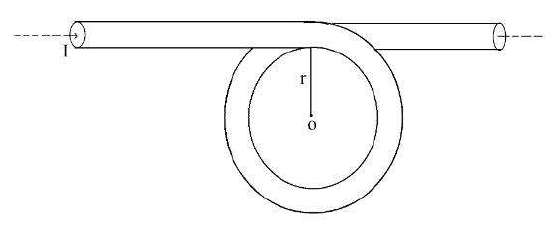
The \( \vec{B} \) at point O is:
Answer & explanation
Correct answer: option 4
The correct answer is Option (4) → \( \displaystyle\frac{\mu_0}{4\pi}\,\frac{2I}{r}(1+\pi) \) perpendicularly inward
The field at O is the vector sum of the fields of the two parts: the long straight wire, which passes at a distance \( r \) above O, and the circular loop of radius \( r \) centred at O.
Straight wire: field of a long straight wire at distance \( r \).
\( \displaystyle B_1 = \frac{\mu_0 I}{2\pi r} = \frac{\mu_0}{4\pi}\,\frac{2I}{r} \)
The current flows from left to right above O, so by the right-hand thumb rule the field at O, below the wire, points into the page.
Circular loop: field at the centre of a circular loop.
\( \displaystyle B_2 = \frac{\mu_0 I}{2r} = \frac{\mu_0}{4\pi}\,\frac{2\pi I}{r} \)
In the figure the wire turns down on the right and goes round the loop clockwise, so this field at O also points into the page.
Both fields are in the same direction, so they add.
\( \displaystyle B = B_1 + B_2 = \frac{\mu_0}{4\pi}\,\frac{2I}{r}(1 + \pi) \quad \text{perpendicularly inward} \)