Which one of the following is an incorrect statement about endosperm production during double fertilization in plants?
Answer & explanation
Correct answer: option 1
The correct answer is Option (1) → Endosperm is produced when one of the two male gametes fuses with the nucleus of the female egg.
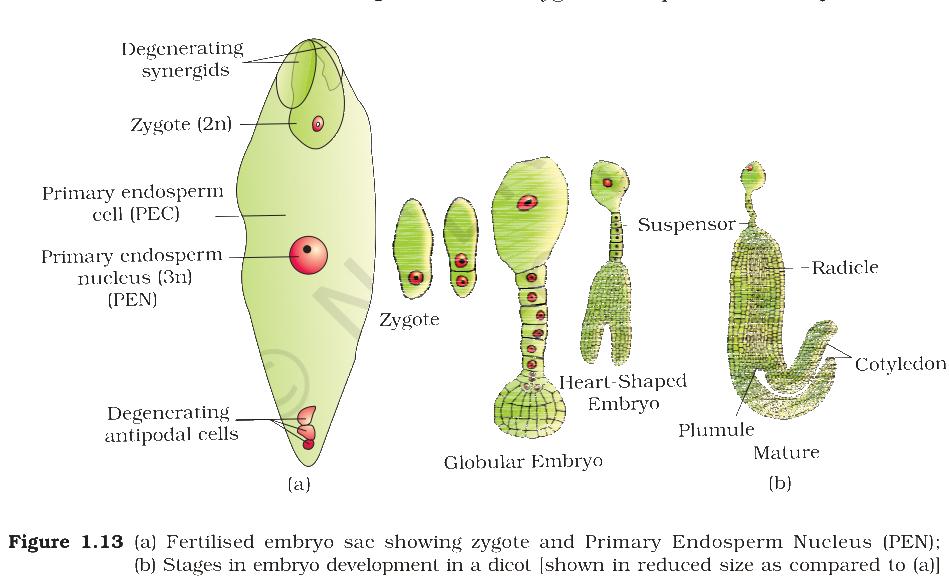
Option (1) Endosperm is produced when one of the two male gametes fuses with the nucleus of the female egg. — An incorrect statement. The fusion of a male gamete with the egg nucleus is syngamy. It gives the diploid zygote, which grows into the embryo, not the endosperm.
Option (2) Endosperm is produced when one of the two male gametes fuses with the two polar nuclei located in the central cell to form a triploid nucleus. — A correct statement. This is triple fusion: one male nucleus and two polar nuclei, three haploid nuclei in all, so the primary endosperm nucleus is triploid (3n).
Option (3) Endosperm tissues are filled with reserve food material and used for nutrition. — A correct statement. The endosperm cells store food. The developing embryo feeds on it.
Option (4) Endosperm of groundnut is completely consumed before seed maturation. — A correct statement. In pea, groundnut and beans the embryo uses up all the endosperm before the seed matures. Such seeds are non-albuminous.
NCERT Extract:
Double Fertilisation – “After entering one of the synergids, the pollen tube releases the two male gametes into the cytoplasm of the synergid. One of the male gametes moves towards the egg cell and fuses with its nucleus thus completing the syngamy. This results in the formation of a diploid cell, the zygote. The other male gamete moves towards the two polar nuclei located in the central cell and fuses with them to produce a triploid primary endosperm nucleus (PEN) (Figure 1.13a). As this involves the fusion of three haploid nuclei it is termed triple fusion.”