
CUETMOCK
  • Pricing
  • Mentors
Log inStart freeStart free mocks→

First test, then trust

Try a free CUET mock test.

Join 5,00,000+ students who rehearsed exam day on the exact NTA screen before sitting CUET. On the web and on Android.

Start free mocks →Get the Android app
CUETMOCK

India's #1 CUET Mock Test Platform. Original NCERT-based questions on the exact NTA exam screen — trusted by 5,00,000+ students since CUET 2022.

Get it onGoogle PlayScan to download the CUETMOCK app

Mock tests

  • CUET mock test series
  • Commerce mocks
  • Humanities (Arts) mocks
  • Science mocks
  • Languages & GAT mocks
  • Free practice questions
  • Pricing

Resources

  • CUET exam guide
  • CUET syllabus
  • Universities accepting CUET
  • Expert blogs
  • News & notifications
  • Webinars & counselling
  • CUET score calculator
  • How we estimate your rank
  • FAQs

Company

  • About us
  • Our leadership & team
  • Our toppers
  • Mentors
  • For schools
  • Contact us
  • Terms
  • Privacy
  • Refund policy

Talk to us

+91 7696 6630 56info@cuetmock.comWhatsApp us

Our other platforms

  • JEE Mock — For IIT-JEE aspirants
  • NEET Mock — For NEET aspirants

Newsletter

Exam updates, study material and offers — no spam.

© 2026 NYC Ventures Pvt. Ltd.

701-702, Royal Business Park, Zirakpur, Punjab - 140603

  • Terms of use
  • Privacy policy
  • Refund policy
  • Contact us

iCUETMOCK is an independent preparation platform, not affiliated with the National Testing Agency (NTA). Always check exam details on the official NTA website.

  • Home
  • Mock tests
  • CUET guide
  • Pricing
  • Log in
Home/Practice questions/Biology
BiologyEvolution

Which of the following reptiles had huge fearsome dagger-like teeth?

Which of the following reptiles had huge fearsome dagger-like teeth?

Answer & explanation+

Correct answer: option 4

The correct answer is Option (4) → Tyrannosaurus rex

Reptiles of many shapes and sizes ruled the earth for about 200 million years. The land reptiles among them were the dinosaurs, and NCERT names the biggest one and describes its teeth.

Option (1) Ichthyosaurs — Incorrect. Ichthyosaurs were land reptiles that went back into water and evolved into fish-like reptiles. NCERT does not describe them with dagger-like teeth.

Option (2) Stegosaurus — Incorrect. Stegosaurus is one of the dinosaurs shown in the family tree of Figure 6.2. It is recognised by the plates along its back, not by fearsome teeth.

Option (3) Brachiosaurus — Incorrect. Brachiosaurus, also shown in Figure 6.2, is the dinosaur with a very long neck. The book does not mention dagger-like teeth for it.

Option (4) Tyrannosaurus rex — Correct. Tyrannosaurus rex was the biggest of the dinosaurs, about 20 feet in height, and had huge fearsome dagger-like teeth.

NCERT Extract:
A Brief Account of Evolution – “… Giant ferns (pteridophytes) were present but they all fell to form coal deposits slowly. Some of these land reptiles went back into water to evolve into fish like reptiles probably 200 mya (e.g. Ichthyosaurs). The land reptiles were, of course, the dinosaurs. The biggest of them, i.e., Tyrannosaurus rex was about 20 feet in height and had huge fearsome dagger like teeth. About 65 mya, the dinosaurs suddenly disappeared from the earth.”
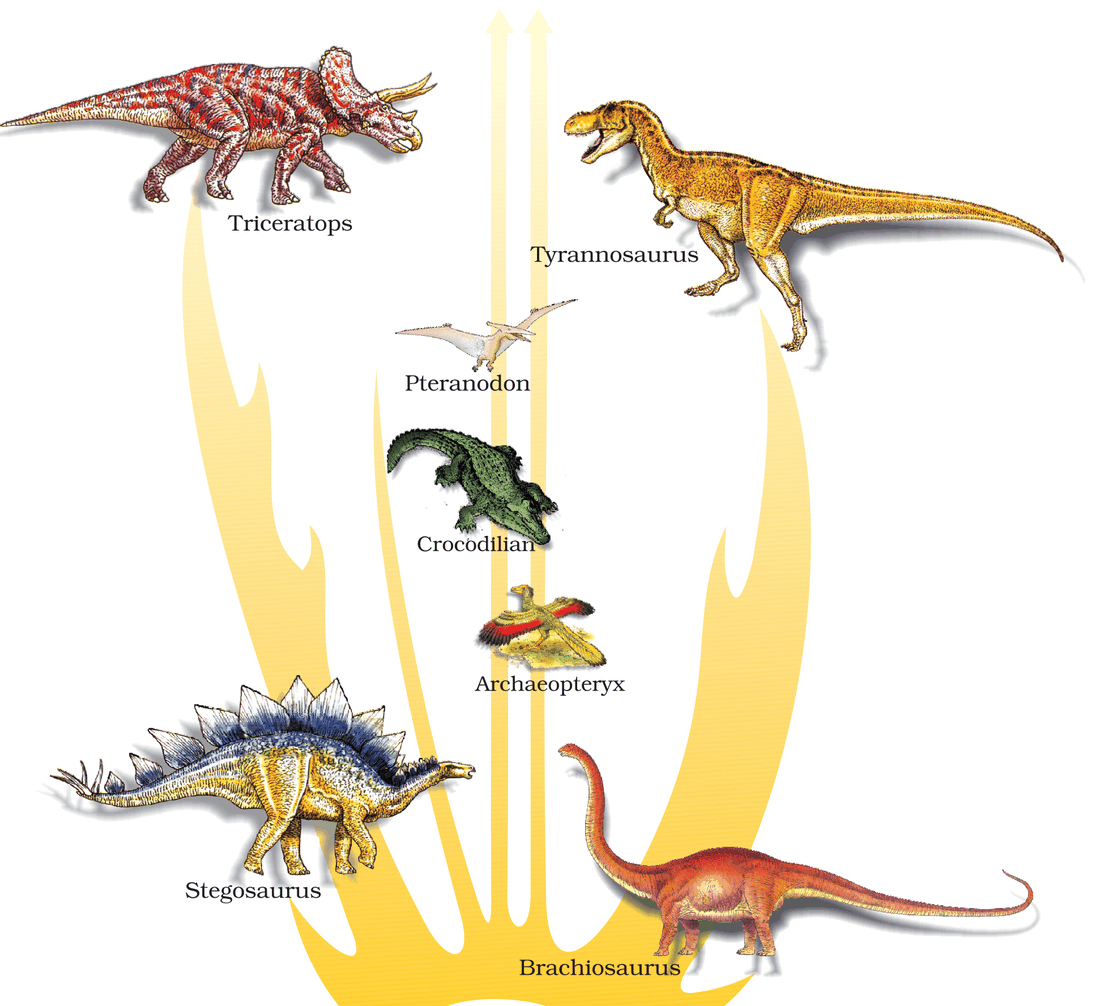
Textbook figure

Figure 6.2 A family tree of dinosaurs and their living modern day counterpart organisms like crocodiles and birds

Advertisement

Practise more on Evolution

Chapter-wise mocks on the real NTA exam screen, with solutions and your rank. Your first mocks are free.

Start free mocks →

Advertisement

Next questions

  1. Arrange the following incidents/policy implementations in the order of their occurrence, related to development in India and its neighbours…Economics · Indian Economic Development: Comparative Development Experiences of India and its Neighbours
  2. Who was the ruler of Delhi sultanate when Ibn Batuta came in India?General Aptitude Test · General Knowledge
  3. Match Column I with Column II: Column I Column II A. Natural ecosystem 1. Producer B. Decomposer 2. Consumer C. Primary productivity 3. For…Biology · Ecosystem
  4. The average age of 15 students of a class is 15 years. Out of these the average age of 5 students is 14 years and that of the other 9 stude…General Aptitude Test · Numerical Ability
  5. Match List I with List II List I List II (A) Benzyl alcohol and phenol (I) Neutral FeCl_3 (B) Phenol and alcohol (II) Lucas reagent (C) Sec…Chemistry · Organic: Aldehydes, Ketones and Carboxylic Acids
  6. वर्तनी की दृष्टि से कौन-सा शब्द शुद्ध है?Hindi · वर्तनी (शब्द शुद्धि)
  7. Five friends' houses are located in an straight line. Amit's house is not near Dipesh's house. Shayana's house is between Brinda's and Shee…General Aptitude Test · Verbal Reasoning
  8. The value of […] isMaths. Section B1 · Determinants
  9. Given below are two statements:Statement I: A fall in the value of the rupee is an economic factor that can affect the management practices…Business Studies · Business Environment
  10. Physics · Nuclei