Match List-I with List-II
| List-I (Definition/Concept) | List-II (Thinker) | ||
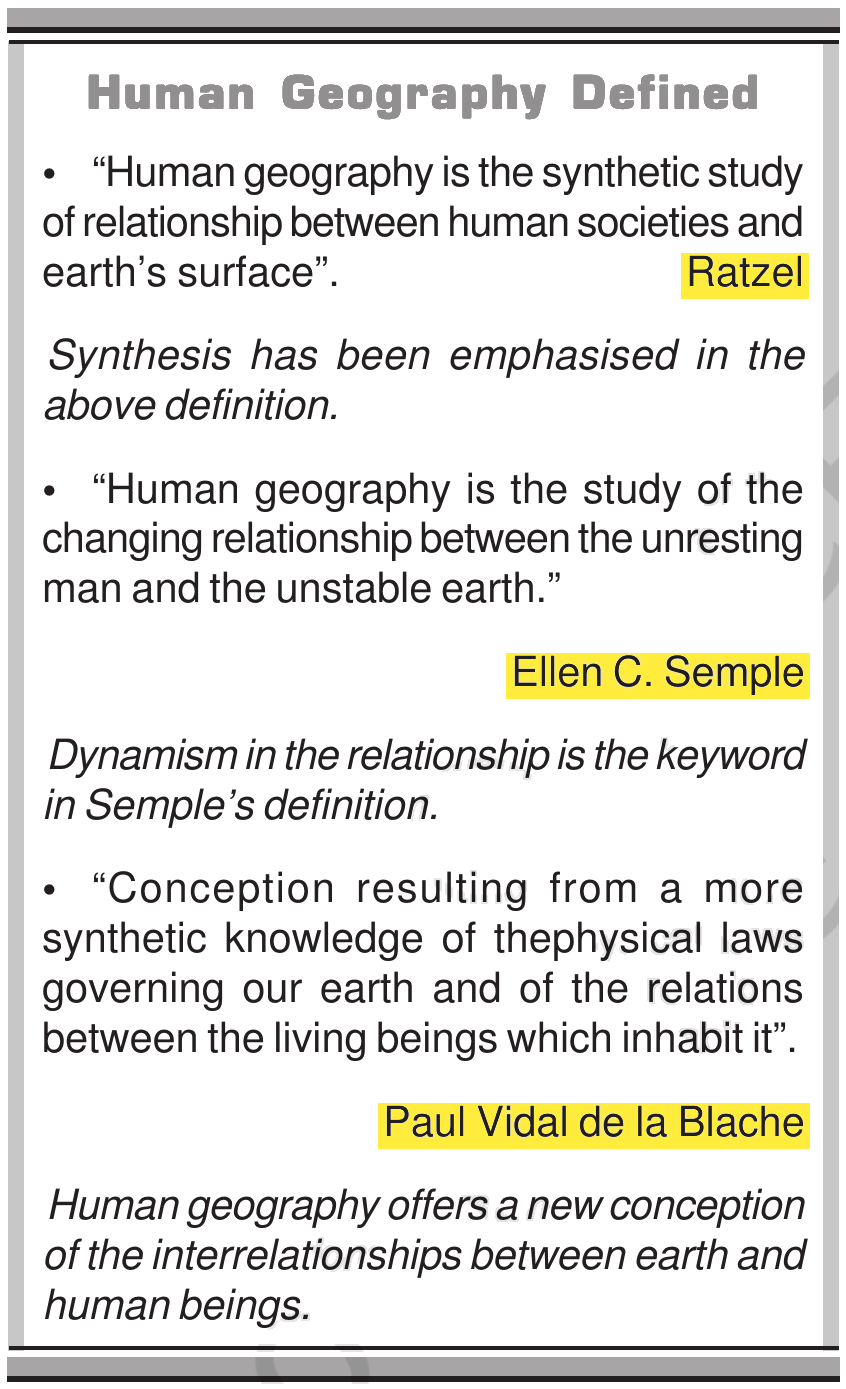
| (A) | "Human geography is the synthetic study of relationship between human societies and earth's surface". | (I) | Blache |
| (B) | "Human geography is the study of the changing relationship between the unresting man and the unstable earth". | (II) | Ratzel |
| (C) | A middle path between the two ideas of Environmentalism and Possibilism | (III) | Semple |
| (D) | "Conception resulting from a more synthetic knowledge of the physical laws governing our earth and of the relations between the living beings which inhabit it" | (IV) | Taylor |
Choose the correct answer from the options given below:
Answer & explanation
Correct answer: option 3
The correct answer is Option (3) → (A)-(II), (B)-(III), (C)-(IV), (D)-(I)
(A) “Human geography is the synthetic study of relationship between human societies and earth’s surface”. — this matches (II) Ratzel. His definition stresses synthesis.
(B) “Human geography is the study of the changing relationship between the unresting man and the unstable earth”. — this matches (III) Semple. Ellen C. Semple’s definition stresses dynamism, a relationship that keeps changing.
(C) A middle path between the two ideas of Environmentalism and Possibilism — this matches (IV) Taylor. Griffith Taylor called it neodeterminism or ‘stop and go determinism’. Environmentalism here means environmental determinism.
(D) “Conception resulting from a more synthetic knowledge of the physical laws governing our earth and of the relations between the living beings which inhabit it” — this matches (I) Blache. This definition is by Paul Vidal de la Blache.
NCERT (2026-27):
Box: Human Geography Defined “A geographer, Griffith Taylor introduced another concept which reflects a middle path (Madhyam Marg) between the two ideas of environmental determinism and possibilism. He termed it as Neodeterminism or stop and go determinism.” |