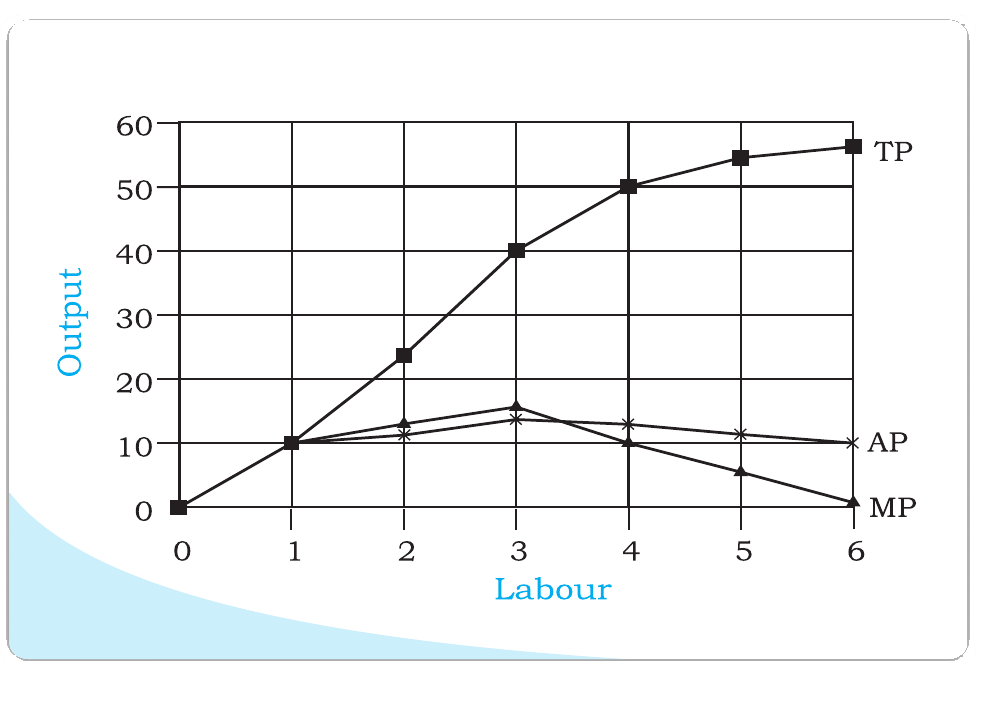
When Marginal productivity starts decreasing but remains positive, Total Productivity is _____.
Answer & explanation
Correct answer: option 4
The correct answer is Option (4) → Increases at diminishing rate.
When marginal product falls but stays positive, each extra unit still adds to output, but adds less than the one before. So total product rises at a diminishing rate.
Marginal product (MP), the question’s marginal productivity, is the extra output from one more unit of the input. Total product (TP), its total productivity, is the whole output. MP shows the rate at which TP changes, so each option depends on what MP is doing.
Option (1) Decreasing. — Incorrect. TP falls only when MP is negative, that is, when one more unit of the input reduces output.
Option (2) Increases at constant rate. — Incorrect. TP rises at a constant rate only when MP stays the same from unit to unit.
Option (3) Increases at Increasing rate. — Incorrect. TP rises at an increasing rate only while MP is rising.
Option (4) Increases at diminishing rate. — Correct. A positive MP keeps TP rising, and a falling MP makes each rise smaller.
NCERT (2026-27): “3.4 The Law of Diminishing Marginal Product and the Law of Variable Proportions … Let us examine what is happening to TP. Notice that TP increases as labour input increases. But the rate at which it increases is not constant. An increase in labour from 1 to 2 increases TP by 10 units. An increase in labour from 2 to 3 increases TP by 12. The rate at which TP increases, as explained above, is shown by the MP. Notice that the MP first increases (upto 3 units of labour) and then begins to fall. This tendency of the MP to first increase and then fall is called the law of variable proportions or the law of diminishing marginal product.… …Law of variable proportions say that the marginal product of a factor input initially rises with its employment level. But after reaching a certain level of employment, it starts falling.…”
|