Identify which of the following concept can be negative?
Answer & explanation
Correct answer: option 3
The correct answer is Option (3) → APS
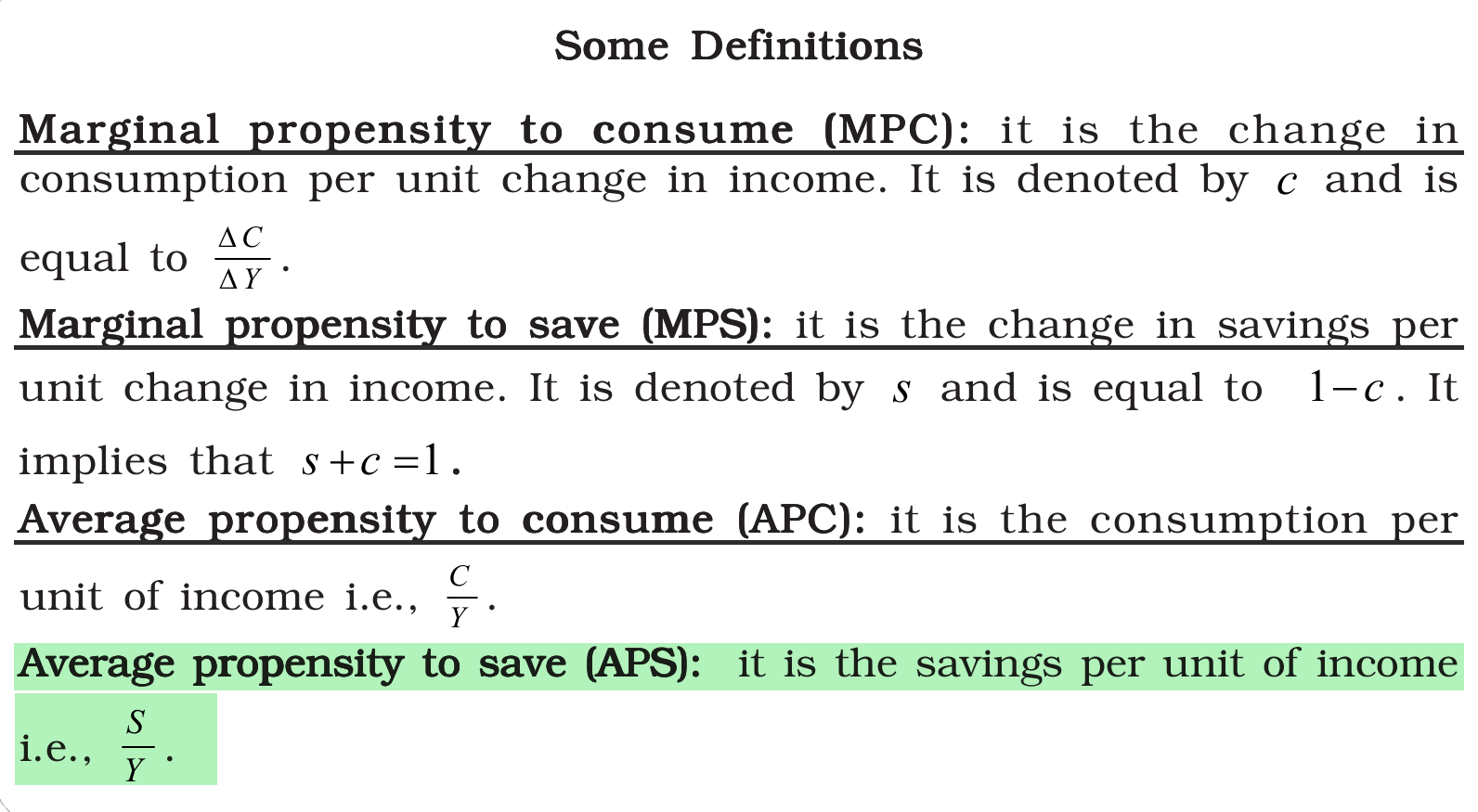
At a low income, people still have autonomous consumption, so consumption can be more than income. Saving (S = Y − C) is then negative. So the average propensity to save (APS), the saving per unit of income (S/Y), is also negative.
Option (1) APC — Incorrect. The average propensity to consume (APC) is consumption per unit of income (C/Y). Consumption never falls below zero, so APC is always positive. At low incomes it is even more than 1.
Option (2) MPC — Incorrect. The marginal propensity to consume (MPC) is the change in consumption per unit change in income. Consumption cannot rise by more than income, and it does not fall when income rises. So MPC lies between 0 and 1.
Option (3) APS — Correct. When people dissave, S is below 0, so S/Y is below 0.
Option (4) MPS — Incorrect. The marginal propensity to save (MPS) is the change in saving per unit change in income. It equals 1 − MPC, so it also lies between 0 and 1.
NCERT (2026-27): “4.1.1. Consumption …The simplest consumption function assumes that consumption changes at a constant rate as income changes. Of course, even if income is zero, some consumption still takes place. Since this level of consumption is independent of income, it is called autonomous consumption.… …Savings is that part of income that is not consumed.…”
|