CUETMOCK
  • Pricing
  • Mentors
Log inStart freeStart free mocks→

First test, then trust

Try a free CUET mock test.

Join 5,00,000+ students who rehearsed exam day on the exact NTA screen before sitting CUET. On the web and on Android.

Start free mocks →Get the Android app
CUETMOCK

India's #1 CUET Mock Test Platform. Original NCERT-based questions on the exact NTA exam screen — trusted by 5,00,000+ students since CUET 2022.

Get it onGoogle PlayScan to download the CUETMOCK app

Mock tests

  • CUET mock test series
  • Browse all papers
  • Commerce mocks
  • Humanities (Arts) mocks
  • Science mocks
  • Languages & GAT mocks
  • Free practice questions
  • Pricing

Resources

  • CUET exam guide
  • CUET syllabus
  • Universities accepting CUET
  • Expert blogs
  • News & notifications
  • Webinars & counselling
  • CUET score calculator
  • How we estimate your rank
  • FAQs

Company

  • About us
  • Our leadership & team
  • Our toppers
  • Mentors
  • For schools
  • Contact us
  • Terms
  • Privacy
  • Refund policy

Talk to us

+91 7696 6630 56info@cuetmock.comWhatsApp us

Our other platforms

  • JEE Mock — For IIT-JEE aspirants
  • NEET Mock — For NEET aspirants

Newsletter

Exam updates, study material and offers — no spam.

© 2026 NYC Ventures Pvt. Ltd.

701-702, Royal Business Park, Zirakpur, Punjab - 140603

  • Terms of use
  • Privacy policy
  • Refund policy
  • Contact us

iCUETMOCK is an independent preparation platform, not affiliated with the National Testing Agency (NTA). Always check exam details on the official NTA website.

  • Home
  • Mock tests
  • CUET guide
  • Pricing
  • Log in
Home/Practice questions/Economics
EconomicsMicro Economics: Market Equilibrium

The market demand curve and the market supply curve of a good are giv…

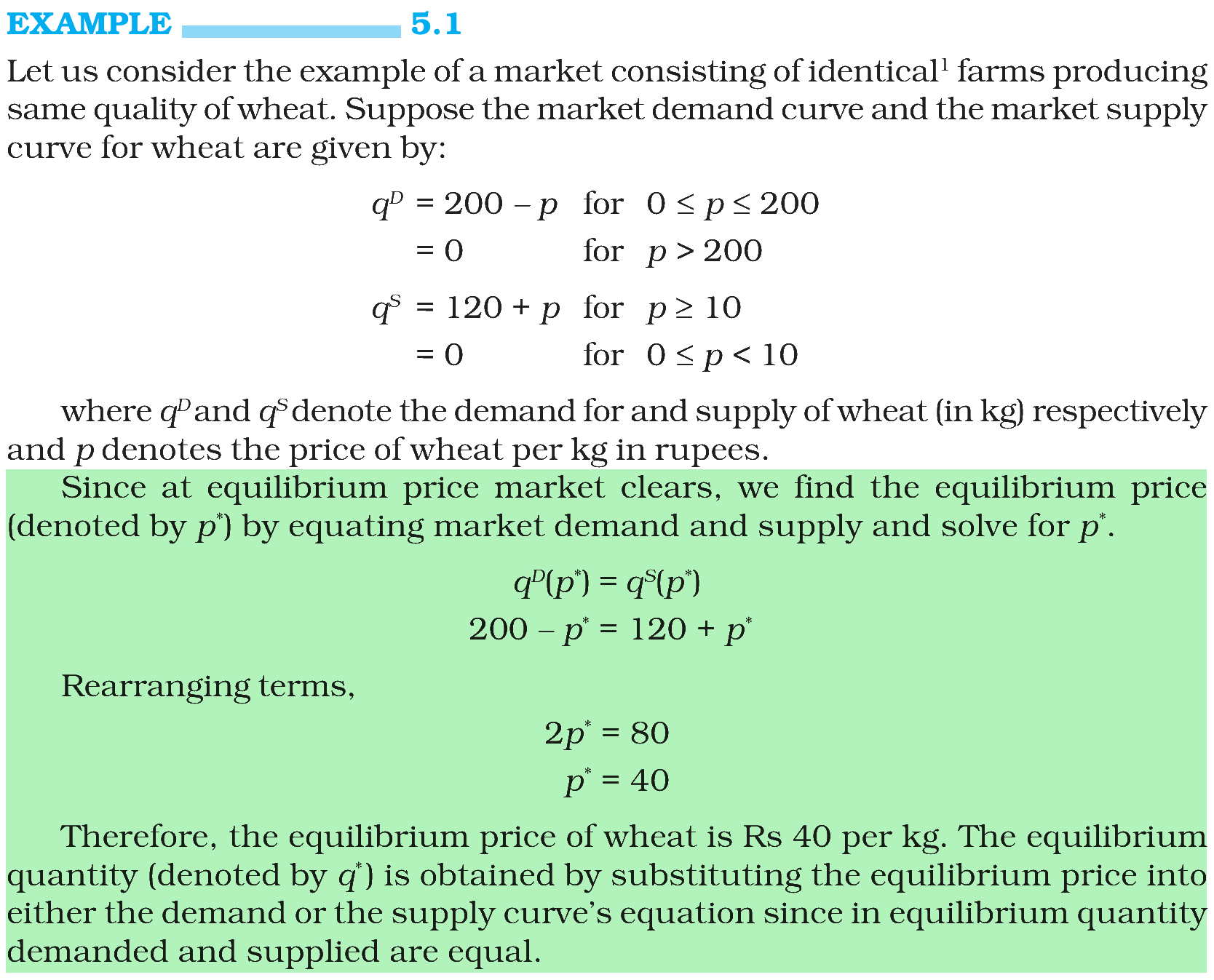
The market demand curve and the market supply curve of a good are given by:

qD = 450 – p for 0<p<450

qS = 150 + p

What will be the equilibrium quantity?

Answer & explanation+

Correct answer: option 3

The correct answer is Option (3) → 300

Given:

qD = 450 − p

qS = 150 + p

First find the equilibrium price, where demand equals supply. Then put it into either equation.

    \( 450 - p = 150 + p \)

    \( 300 = 2p \)

    \( p^* = 150 \)

    \( q^* = 450 - 150 = 300 \)

The equilibrium quantity is 300 units.

Option (1) 150 — this is the equilibrium price, not the quantity.

NCERT (2026-27): NCERT extract

NCERT extract

Advertisement

Practise more on Micro Economics: Market Equilibrium

Chapter-wise mocks on the real NTA exam screen, with solutions and your rank. Your first mocks are free.

Start free mocks →

Advertisement

Next questions

  1. Identify which of the following concept can be negative?Economics · Macro Economics: Determination of Income and Employment
  2. During a journey of 200 km, the average speed of a car is 125 km/h. But if for the first 100 km, the driver increases its earlier average s…General Aptitude Test · Numerical Ability
  3. Which of the following Institution was set up through 'Rome Statute"?Legal Studies · International Context
  4. Select the set in which the numbers are related in the same way as are the numbers of the given set. (NOTE: Operations should be performed…General Aptitude Test · Verbal Reasoning
  5. Why are consumers willing to pay a premium amount for whole foods?English · Comprehension - (Narrative / Factual)
  6. Select the most appropriate meaning of the given idiom. Add fuel to the fireEnglish · Grammar: Idioms
  7. What is the area of the square (in cm2) whose vertices lie on a circle of radius 5 cm?General Aptitude Test · Quantitative Reasoning
  8. Which of the following is incorrect in the context of caste system in post independence India?Sociology · Indian Society: Continuity and Change
  9. From the given options, select the Figure of Speech (Poetic Device) used in the expression: O Judgement! thou art fled to brutish beasts.English · Figure of Speech
  10. A bond has a face value of Rs 1,000. It pays Rs 80 at the end of every year for three years and returns the principal at the end of the thi…Economics · Macro Economics: Money and Banking