Isopropyl alcohol when treated with heated Cu at 573 K gives
Answer & explanation
Correct answer: option 1
The correct answer is Option (1) → Acetone
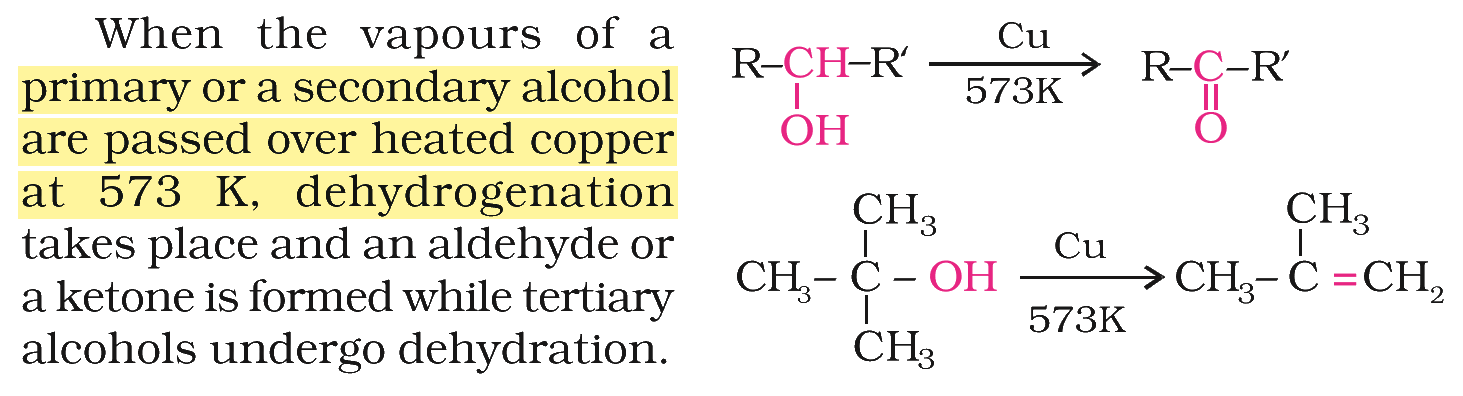
When the vapours of an alcohol are passed over heated copper at 573 K, the result depends on the class of the alcohol:
Primary alcohol: dehydrogenation gives an aldehyde (ethanol gives ethanal).
Secondary alcohol: dehydrogenation gives a ketone.
Tertiary alcohol: it has no hydrogen on the carbinol carbon, so it undergoes dehydration to an alkene (2-methylpropan-2-ol gives 2-methylpropene).
Isopropyl alcohol (propan-2-ol) is a secondary alcohol, so it loses hydrogen to give acetone:
\( \displaystyle \ce{CH3-CH(OH)-CH3} \xrightarrow{\text{Cu, 573 K}} \ce{CH3-CO-CH3 + H2} \)
So the product is acetone (propanone).
Why the other options are incorrect
Option (2) Acetic acid — Incorrect. It has only two carbon atoms and is obtained by oxidation of ethanol or ethanal with a strong oxidising agent, not by dehydrogenation:
\( \displaystyle \ce{CH3CH2OH} \xrightarrow{\text{acidified }\ce{KMnO4}} \ce{CH3COOH} \)
Option (3) Acetaldehyde — Incorrect. It is the product from ethanol, a primary alcohol, under the same conditions:
\( \displaystyle \ce{CH3CH2OH} \xrightarrow{\text{Cu, 573 K}} \ce{CH3CHO + H2} \)
Option (4) Propene — Incorrect. It forms by dehydration of propan-2-ol with concentrated \( \ce{H2SO4} \); heated copper gives an alkene only with tertiary alcohols:
\( \displaystyle \ce{CH3-CH(OH)-CH3} \xrightarrow[\text{heat}]{\text{conc. }\ce{H2SO4}} \ce{CH3-CH=CH2 + H2O} \)
NCERT (2026-27 edition):
Chemical Reactions – …