CUETMOCK
  • Pricing
  • Mentors
Log inStart freeStart free mocks→

First test, then trust

Try a free CUET mock test.

Join 5,00,000+ students who rehearsed exam day on the exact NTA screen before sitting CUET. On the web and on Android.

Start free mocks →Get the Android app
CUETMOCK

India's #1 CUET Mock Test Platform. Original NCERT-based questions on the exact NTA exam screen — trusted by 5,00,000+ students since CUET 2022.

Get it onGoogle PlayScan to download the CUETMOCK app

Mock tests

  • CUET mock test series
  • Browse all papers
  • Commerce mocks
  • Humanities (Arts) mocks
  • Science mocks
  • Languages & GAT mocks
  • Free practice questions
  • Pricing

Resources

  • CUET exam guide
  • CUET syllabus
  • Universities accepting CUET
  • Expert blogs
  • News & notifications
  • Webinars & counselling
  • CUET score calculator
  • How we estimate your rank
  • FAQs

Company

  • About us
  • Our leadership & team
  • Our toppers
  • Mentors
  • For schools
  • Contact us
  • Terms
  • Privacy
  • Refund policy

Talk to us

+91 7696 6630 56info@cuetmock.comWhatsApp us

Our other platforms

  • JEE Mock — For IIT-JEE aspirants
  • NEET Mock — For NEET aspirants

Newsletter

Exam updates, study material and offers — no spam.

© 2026 NYC Ventures Pvt. Ltd.

701-702, Royal Business Park, Zirakpur, Punjab - 140603

  • Terms of use
  • Privacy policy
  • Refund policy
  • Contact us

iCUETMOCK is an independent preparation platform, not affiliated with the National Testing Agency (NTA). Always check exam details on the official NTA website.

  • Home
  • Mock tests
  • CUET guide
  • Pricing
  • Log in
Home/Practice questions/Economics
EconomicsMicro Economics: Market Equilibrium

In case of normal goods, rise in consumer's income will lead to:

In case of normal goods, rise in consumer's income will lead to:

Answer & explanation+

Correct answer: option 4

The correct answer is Option (4) → Increase in equilibrium price.

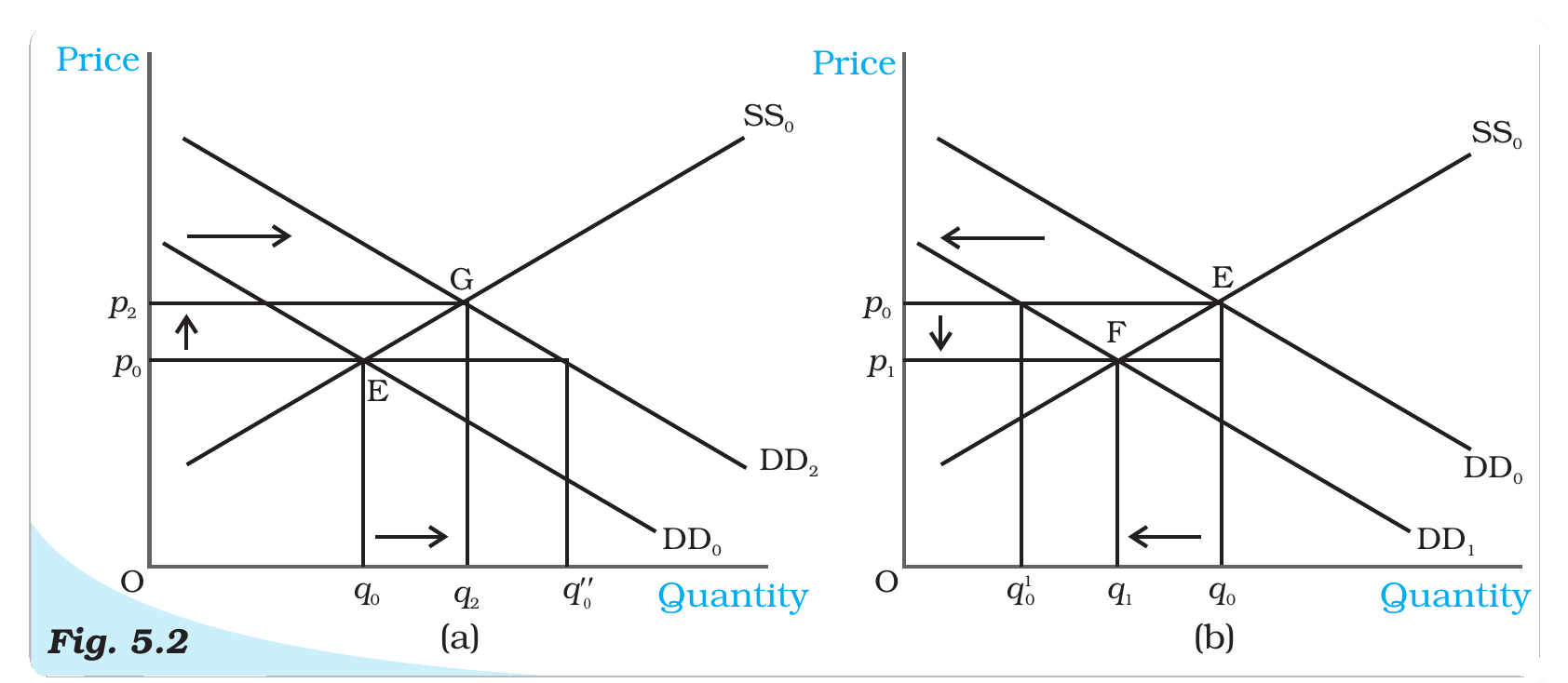
A normal good is one that people buy more of when their income rises. So a rise in income pushes its price up, step by step:

  • With prices of other goods and tastes unchanged, consumers want more of the good at every price, so the market demand curve shifts to the right.

  • Income does not affect the supply curve, which depends on technology and costs, so it stays where it was.

  • At the old price there is now excess demand; some buyers are willing to pay more, and the price rises until a new equilibrium is reached at a higher price and a larger quantity.

Why the other options are incorrect

  • Option (1) Decrease in equilibrium quantity. — Incorrect. With a rightward shift of demand and supply unchanged, the equilibrium quantity rises. A fall would follow a rise in income only for an inferior good.

  • Option (2) Constant equilibrium price. — Incorrect. The price would stay the same only if supply were perfectly elastic. With an upward-sloping supply curve, excess demand at the old price pushes the price up.

  • Option (3) Decrease in equilibrium price. — Incorrect. A fall in price follows a leftward shift of demand. A rightward shift raises the price.


NCERT (2025-26): “Demand Shift … Suppose due to a hike in the salaries of the consumers, their incomes increase. How would it affect equilibrium? With an increase in income, consumers are able to spend more money on some goods. But recall from Chapter 2 that the consumers will spend less on an inferior good with increase in income whereas for a normal good, with prices of all commodities and tastes and preferences of the consumers held constant, we would expect the demand for the good to increase at each price as a result of which the market demand curve will shift rightward. Here we consider the example of a normal good like clothes, the demand for which increases with increase in income of consumers, thereby causing a rightward shift in the demand curve. However, this income increase does not have any impact on the supply curve, which shifts only due to some changes in the factors relating to technology or cost of production of the firms. Thus, the supply curve remains unchanged. In the Figure 5.2 (a), this is shown by a shift in the demand curve from DD0 to DD2 but the supply curve remains unchanged at SS0. From the figure, it is clear that at the new equilibrium, the price of clothes is higher and the quantity demanded and sold is also higher.…”

NCERT extract

Advertisement

Practise more on Micro Economics: Market Equilibrium

Chapter-wise mocks on the real NTA exam screen, with solutions and your rank. Your first mocks are free.

Start free mocks →

Advertisement

Next questions

  1. Why does central bank is called the lender of last resort?Economics · Macro Economics: Money and Banking
  2. Sam talks about an example of an igneous rock. Which of the following can it be?General Aptitude Test · General Knowledge
  3. Which of the following limitations is highlighted in the above passage?Business Studies · Planning
  4. At a certain rate simple interest per annum, a certain sum amounts to ₹24,000 in 7 years and to ₹32,000 in 12 years. What is the rate of si…General Aptitude Test · Numerical Ability
  5. How does Deven respond to the poet's accusation?English · Comprehension - (Narrative / Factual)
  6. A firm raises all its inputs from 2 units of labour and 3 units of capital to 4 units of labour and 6 units of capital, and its output rise…Economics · Micro Economics: Production and Costs
  7. Select the correctly spelt word.English · Spelling Check
  8. K. G. Subramanyan was a founding member of the Baroda Art School. What did he want art to be made a part of?Fine Arts · The Modern Indian Art
  9. Which of the following statements are correct about microbes?(A) All microbes are pathogenic(B) Microbes can grow at 80°C temperature(C) Mi…Biology · Microbes in Human Welfare
  10. Match the following: a) Interpersonal Skills i) ability to be sensitive to one’s own behaviour or others b) Affective Skills ii) ability to…Psychology · Developing Psychological Skills