About linear programming problem (LPP), which of the following statements are correct?
(A) In a LPP, the linear inequalities or restrictions on the variables are called linear constraints.
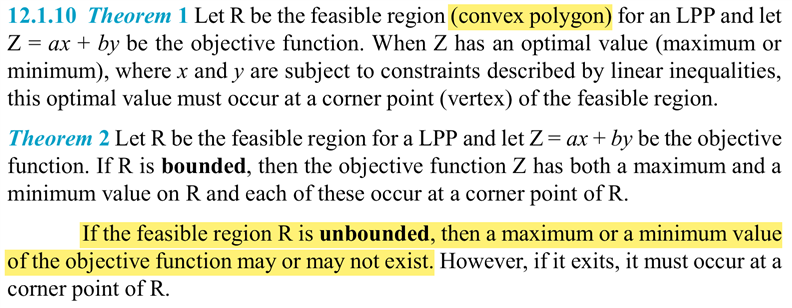
(B) If the feasible region for an LPP is unbounded, then the maximum or minimum value of the objective function \(Z = ax + by\) never exists.
(C) The feasible region for an LPP is always convex.
(D) The common region determined by all the linear constraints of an LPP is called the feasible region.
Choose the correct answer from the options given below:
Answer & explanation
Correct answer: option 2
The correct answer is Option (2) → (A), (C) and (D) only
(A) In a LPP, the linear inequalities or restrictions on the variables are called linear constraints. — Correct. This is the definition of linear constraints.
(B) If the feasible region for an LPP is unbounded, then the maximum or minimum value of the objective function \(Z = ax + by\) never exists. — Incorrect. On an unbounded region the maximum or minimum may still exist. For example, with \(x + y \ge 2,\ x \ge 0,\ y \ge 0\) the region is unbounded, yet \(Z = x + y\) has the minimum value 2. The word “never” makes the statement false.
(C) The feasible region for an LPP is always convex. — Correct. Each linear constraint gives a half-plane, which is convex, and the common part of convex sets is convex.
(D) The common region determined by all the linear constraints of an LPP is called the feasible region. — Correct. This is the definition of the feasible region.
NCERT Exemplar:
Linear Programming