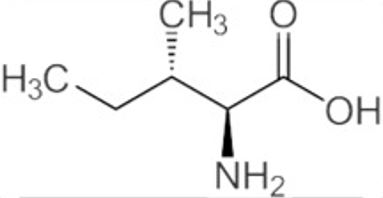
Match List-I (amino acid) with List-II (Characteristic Side Chain)
|
List-I Amino acid |
List-II Characteristic Side Chain |
|
(A) Phenylalanine |
(I) $(CH_3)_2CHCH_2-$ |
|
(B) Leucine |
(II) $C_6H_5CH_2-$ |
|
(C) Lysine |
(III) $CH_3-CH_2-CH(CH_3)-$ |
|
(D) Isoleucine |
(IV) $H_2N-(CH_2)_4-$ |
Choose the correct answer from the options given below:
Answer & explanation
Correct answer: option 1
The correct answer is Option (1) → (A)-(II), (B)-(I), (C)-(IV), (D)-(III)
Amino acids differ in the R-group (side chain) attached to the a-carbon. Identification of amino acids is often based on their characteristic side chains:
- Aromatic ring → Phenylalanine
- Branched alkyl chain → Leucine / Isoleucine
- Long chain ending in $-NH_2$ → Lysine
Matching Explanation
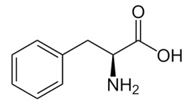
(A) Phenylalanine → (II) $C_6H_5CH_2-$
Phenylalanine contains a benzyl group (phenyl ring + $CH_2$). This aromatic side chain makes it nonpolar and hydrophobic. So it matches with the phenyl-containing group.
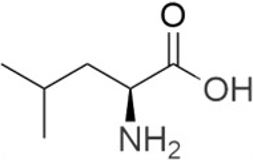
(B) Leucine → (I) $(CH_3)_2CHCH_2-$
Leucine has an isobutyl side chain. It is a branched-chain, hydrophobic amino acid. The structure matches $(CH_3)_2CHCH_2-$.
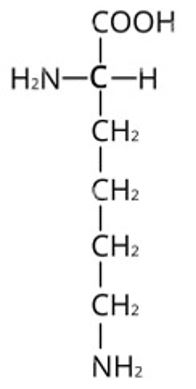
(C) Lysine → (IV) $H_2N-(CH_2)_4-$
Lysine contains a long aliphatic chain ending in an amino group. This makes lysine a basic amino acid. Hence, it corresponds to $H_2N-(CH_2)_4-$.
(D) Isoleucine → (III) $CH_3-CH_2-CH(CH_3)-$
Isoleucine has a sec-butyl side chain. It is also branched but differs from leucine in branching position. This matches $CH_3-CH_2-CH(CH_3)-$.