
In the relation \( \Phi_B=BA\cos\theta \), the angle \( \theta \) is the angle
Answer & explanation
Correct answer: option 2
The correct answer is Option (2) → which the normal to the surface makes with the direction of the magnetic field
The magnetic flux is \( \Phi_B=BA\cos\theta \), where the area vector \( \vec{A} \) has magnitude \( A \) and points along the normal to the surface.
Option (1) which the magnetic field makes with the surface — Incorrect. The angle with the surface is \( 90^\circ-\theta \). With it, \( BA\cos\theta \) would give the largest flux for a field lying along the surface, where no field lines cross it at all.
Option (2) which the normal to the surface makes with the direction of the magnetic field — Correct. \( \theta \) is the angle between \( \vec{B} \) and \( \vec{A} \), and \( \vec{A} \) lies along the normal. The flux is largest, \( BA \), when the field is along the normal (\( \theta=0^\circ \)). It is zero when the field lies in the plane of the surface (\( \theta=90^\circ \)).
Option (3) which is never constant — Incorrect. For a fixed surface in a uniform field the angle stays constant. It changes only when the surface turns, as the coil of an ac generator does.
NCERT (2026-27):
Magnetic Flux – “… Magnetic flux through a plane of area A placed in a uniform magnetic field B (Fig. 6.4) can be written as
\( \Phi_B=\mathbf{B}\cdot\mathbf{A}=BA\cos\theta \qquad (6.1) \)
where θ is angle between B and A.”
Electric Flux – “… the normal to the plane specifies the orientation of the plane. Thus the direction of a planar area vector is along its normal.”
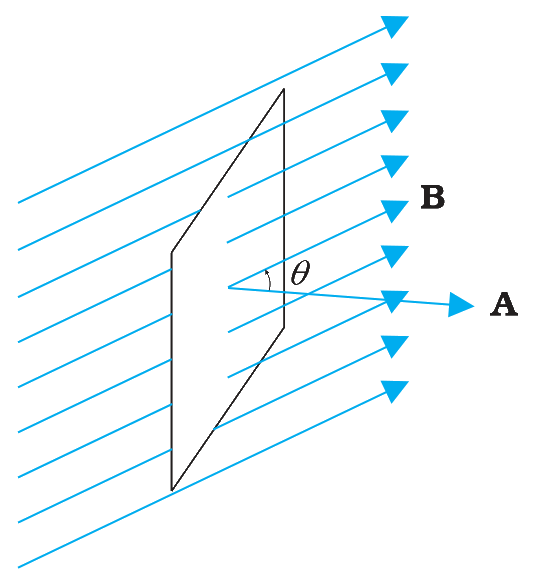
Fig. 6.4: A plane of surface area A placed in a uniform magnetic field B.