
The correct order of basicity of amines in water is which of the following?
Answer & explanation
Correct answer: option 1
The correct answer is Option (1) → (CH3)2NH > CH3NH2 > (CH3)3N
An amine acts as a base by accepting a proton from water; the more stable the cation formed, the stronger the base:
\( \displaystyle \ce{R-NH2 + H2O <=> R-NH3^+ + OH^-} \)
In water two effects decide this. The +I effect of alkyl groups pushes electrons to nitrogen and stabilises the cation; it grows with the number of alkyl groups. Solvation by hydrogen bonding with water also stabilises the cation; it grows with the number of N–H hydrogens on the cation. Methyl groups are small, so they do not hinder this hydrogen bonding.
(CH3)2NH (dimethylamine) — first (strongest base). Two methyl groups give a strong +I effect, and its cation \( \ce{(CH3)2NH2^+} \) still has two N–H hydrogens for hydrogen bonding with water. It has the best balance of the two effects.
CH3NH2 (methylamine) — second. One methyl group gives a weaker +I effect, but its cation \( \ce{CH3NH3^+} \) has three N–H hydrogens and is solvated best, which makes up for much of it.
(CH3)3N (trimethylamine) — third (weakest base). It has the strongest +I effect, but its cation \( \ce{(CH3)3NH^+} \) has only one N–H hydrogen, so it is the least stabilised by solvation.
NCERT (2026-27 edition):
(a) Alkanamines versus ammonia
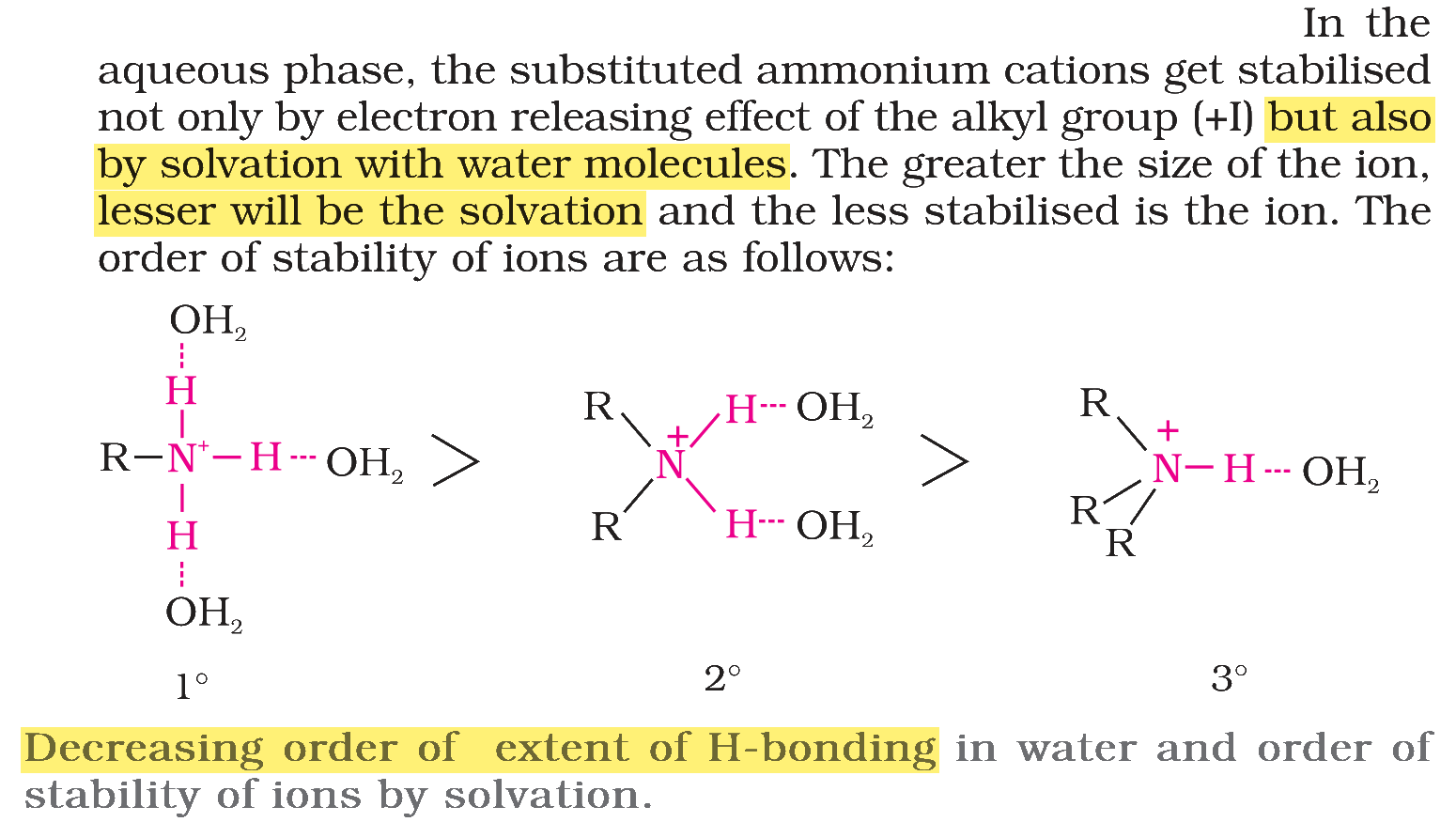
(a) Alkanamines versus ammonia (continued) – “Greater is the stability of the substituted ammonium cation, stronger should be the corresponding amine as a base. Thus, the order of basicity of aliphatic amines should be: primary > secondary > tertiary, which is opposite to the inductive effect based order. Secondly, when the alkyl group is small, like –CH3 group, there is no steric hindrance to H-bonding. … Thus, there is a subtle interplay of the inductive effect, solvation effect and steric hinderance of the alkyl group which decides the basic strength of alkyl amines in the aqueous state. The order of basic strength in case of methyl substituted amines and ethyl substituted amines in aqueous solution is as follows:
…
(CH3)2NH > CH3NH2 > (CH3)3N > NH3”