Electrochemistry
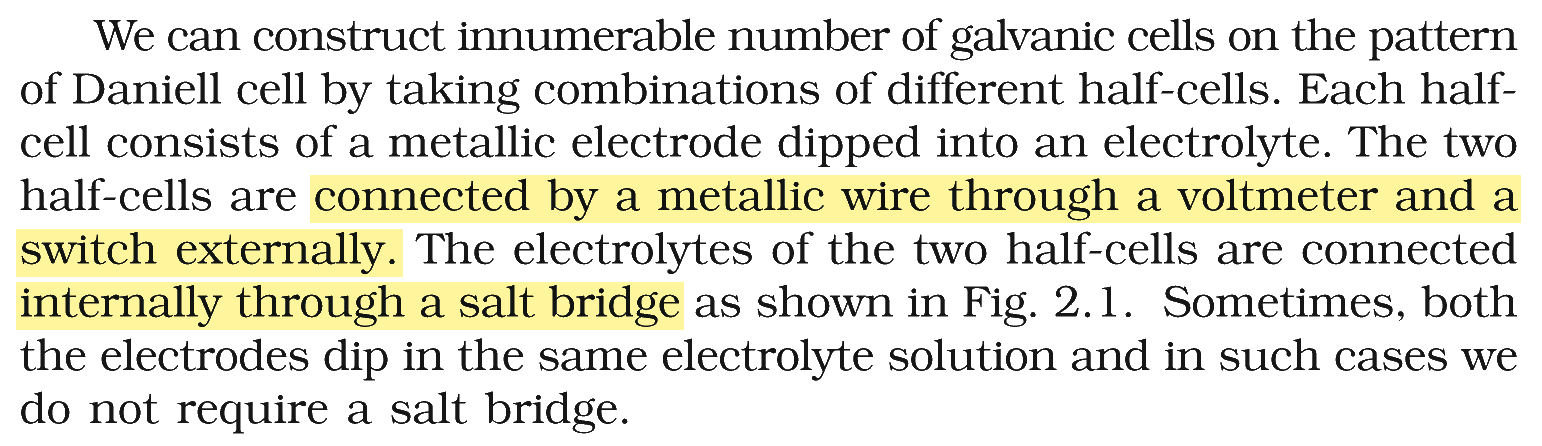
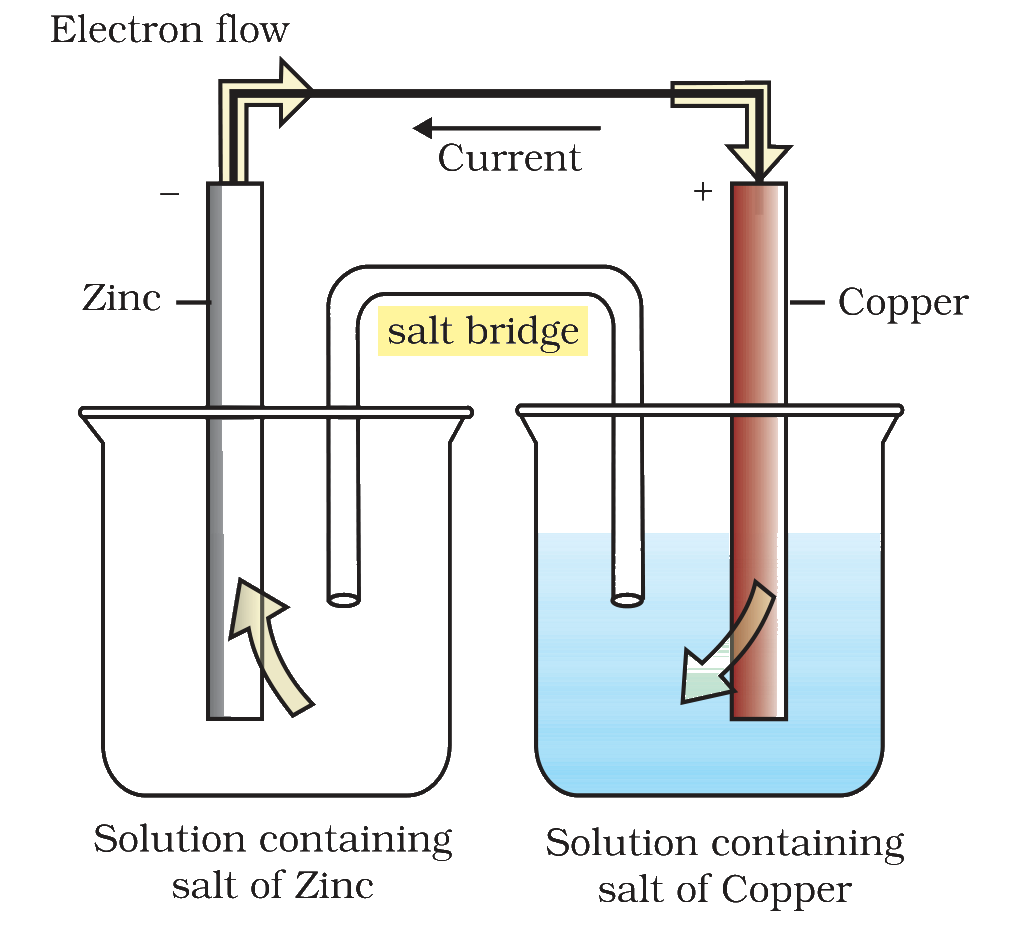
A galvanic cell is an electrochemical cell that converts the chemical energy of a spontaneous redox reaction into electrical energy whereas, an electrolytic cell is a device which uses electrical energy to carry out the non-spontaneous chemical reactions. We can construct innumerable number of galvanic cells on the pattern of Daniell cell (Cu-Zn cell) by taking combinations of different half-cells. Each half-cell consists of a metallic electrode dipped into an electrolyte. The two half-cells are connected by a metallic wire through a voltmeter and a switch externally. The electrolytes of the two half-cells are connected internally through a salt bridge. In a galvanic cell, the half-cell in which oxidation takes place is called anode and it has a negative potential with respect to the solution and in an accepted convention we keep the anode on the left and the cathode on the right side. The potential difference between the two electrodes of a galvanic cell is called the cell potential and is measured in volts. The cell potential is the difference between the electrode potentials (reduction potentials) of the cathode and anode. It is called the cell electromotive force (emf) of the cell when no current is drawn through the cell.
Which of the following statements is wrong for a salt bridge?
Answer & explanation
Correct answer: option 3
The correct answer is Option (3) → It completes the external circuit of the cell.
A salt bridge is usually an inverted U-tube filled with a gel (agar-agar) containing an inert electrolyte such as KCl, \( \ce{KNO3} \) or \( \ce{NH4NO3} \). It joins the two electrolyte solutions of a galvanic cell. Its ions move into the two half-cells, so it:
completes the internal circuit of the cell (ions carry the current through it), and
keeps each solution electrically neutral, so the reaction can continue.
Option (1) It is generally an inverted U-shaped tube. — A correct statement about a salt bridge. This is its usual form.
Option (2) It is used to maintain electrical neutrality in electrolytic solutions. — A correct statement about a salt bridge. Without it, positive charge would build up around the anode and negative charge around the cathode, and the current would stop.
Option (3) It completes the external circuit of the cell. — A wrong statement about a salt bridge. The salt bridge completes the internal circuit; the external circuit is the metallic wire joining the electrodes, through which electrons flow.
Option (4) It is represented by putting a double vertical line. — A correct statement about a salt bridge. In cell notation, “||” stands for the salt bridge.
NCERT (2026-27 edition):
Galvanic Cells – …