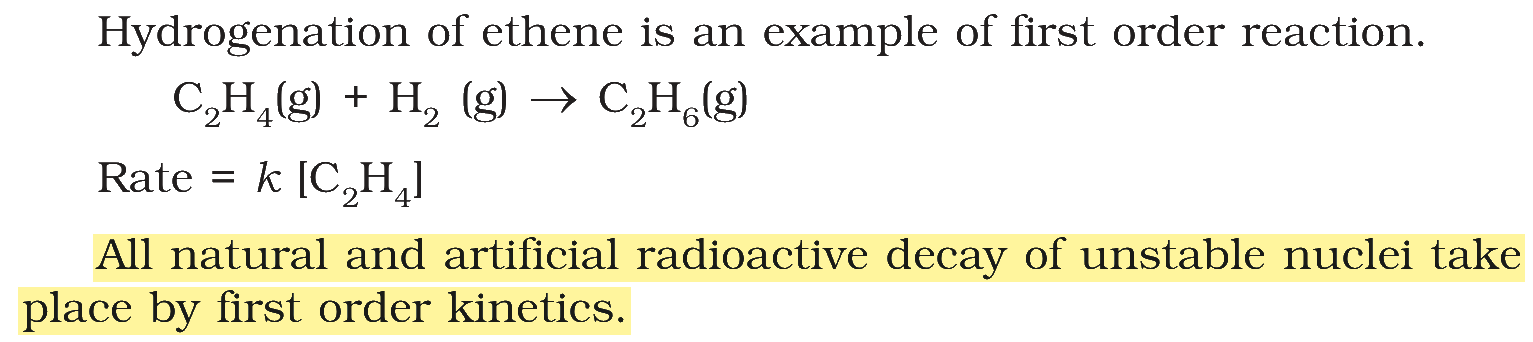
All natural and artificial radioactive decay of unstable nuclei take place by
Answer & explanation
Correct answer: option 2
The correct answer is Option (2) → First order kinetics
In a first order reaction the rate is proportional to the first power of the concentration of the reactant: Rate \( = k[\mathrm{R}] \). Its half-life, \( t_{1/2} = 0.693/k \), does not depend on how much reactant is present.
Radioactive decay fits this law. Each unstable nucleus decays on its own, without colliding with anything, so the number of nuclei decaying per second is proportional to the number of nuclei present:
\( \displaystyle ^{226}_{88}\mathrm{Ra} \rightarrow\, ^{222}_{86}\mathrm{Rn} + \,^{4}_{2}\mathrm{He} \qquad \text{Rate} = k[\mathrm{Ra}] \)
That is why every radioactive isotope has a fixed half-life (for example, about 5730 years for carbon-14), whatever the amount of sample. So radioactive decay takes place by first order kinetics.
Why the other options are incorrect
Option (1) Zero order kinetics — Incorrect. The rate would stay the same as the sample decays; in fact the activity falls as the number of nuclei falls.
Option (3) Second order kinetics — Incorrect. The rate would depend on two concentration terms, as when two species must collide; a nucleus decays alone.
Option (4) Third order kinetics — Incorrect. This would need three concentration terms; it has no connection with the spontaneous decay of single nuclei.
NCERT (2026-27 edition):
First Order Reactions – …